
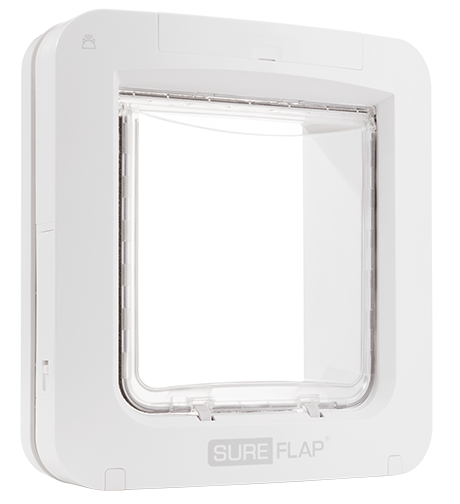
SureFlap Microchip Pet Door Connect: Specs, Pros & Cons
SureFlap put the microchip reader on this door's outside face and nowhere else. The Microchip Pet Door Connect checks every animal coming in and none going out. A neighbor's cat stays outside. Any pet of yours can leave whenever the flap is unlocked for exit, as Sure Petcare says on the product page and again in the manual.
The door reads the microchip a vet has already implanted, and one RFID collar tag is included for a pet that has none. Sure Petcare says its doors work with all common microchips. The product page has a checker where you can type in your pet's chip number before buying. The door is sized for large cats and small dogs. Its locking modes and curfew are set with buttons on the door itself, and the manual says it works as a standard Microchip Pet Door without the Hub.
The Connect in the name is that Hub, the Sure Petcare Hub, which is sold separately. It plugs into a spare Ethernet port on your router and talks to the door wirelessly. Once the two are paired, the Sure Petcare app logs each pet's trips and sends a notification as they come and go. It also lets you lock the door or move the curfew from anywhere.
Glass, metal doors and walls all need extra parts. The manual says glass takes a new pane with the hole cut by a glazier, plus SureFlap's mounting adaptor. A door with metal inside and a wall both need SureFlap fitting accessories. A wooden or plastic door can take it with the screws that come in the box.
How this VS Score was computed
Score 0: each known spec is measured against the median of all smart pet doors (1 products), then weighted. 0% of the scoreable weight could be used. See how we score
Not scored: Microchip recognition (too few comparable peers (1, need 3)); RFID collar tag (too few comparable peers (1, need 3)); Registered pets (too few comparable peers (1, need 3)); Curfew mode (too few comparable peers (1, need 3)); Selective entry / exit (too few comparable peers (1, need 3)); Locking modes (too few comparable peers (1, need 3)); App control (too few comparable peers (1, need 3)); Activity log (too few comparable peers (1, need 3)); Hub required (too few comparable peers (1, need 3)); Voice assistant (unknown: not scored); Flap opening width (unknown: not scored); Flap opening height (too few comparable peers (1, need 3)); Max pet size (too few comparable peers (1, need 3)); Installation surfaces (too few comparable peers (1, need 3)); Battery life (too few comparable peers (1, need 3)); Low-battery alert (too few comparable peers (1, need 3)); Draught excluder (too few comparable peers (1, need 3)).
Editor’s note
Sure Petcare rates this Connect door at up to 6 months on four C cells, and its plain Microchip Pet Door at up to 12 months on the same cells. Both doors have the same outside reader, the same flap opening and the same curfew at the door. Only the Hub link separates them, and the shorter battery rating is its running cost.
Pay for the Connect only if someone in the house will open the app. The trip history helps when a pet's routine changes and you want to see exactly when. Remote locking is for the afternoon you're out and want the flap shut before a storm. Shared app access lets a pet sitter do the same, with the permissions you set. If none of that sounds like you, the plain door keeps strays out just as well and needs fresh batteries half as often.
Pressing the lock mode button on the door overrides any curfew set in the app, the manual warns, so anyone who changes the mode by hand also cancels the schedule.
The manual wants the Hub within about 10 meters of the door, in line of sight where possible and away from large metal objects such as a fridge. It also needs a wired router port. A router at the far end of the house may mean a longer Ethernet cable or a powerline adapter, and the manual suggests both for that case.
Sure Petcare's US and UK pages disagree on the flap width. The US page gives 7.5 inches. The UK page gives 178 mm, about 7 inches, and both agree on the height. Measure the widest part of your pet against the smaller figure before cutting a hole in anything.
Specifications
Access control
Smart features
Fit & installation
Power & weatherproofing
Sources and verification
Where the specifications come from
- Official product pagesurepetcare.com
- Support and firmware documentationplay.google.com
- Retailer listing (cross-check)amazon.com
Verification
- First published
- Specifications last checked
- Sheet completeness
- 16 of 19 specifications verified; the rest show as Unknown and are never estimated or scored
- Page type
- Product specification page — Compiled from the manufacturer’s published specifications and the cited sources; this is not a hands-on test.
- Basis
- Research-based: specifications and editorial text were compiled from the documents listed here and the manufacturer’s published data. We have not tested this unit ourselves; where independent measurements are mentioned they belong to the linked publication.
Where to buy
Prices and availability may change. Check the retailer before buying. We may earn a commission on purchases.
Price history
Ratings & reviews
No reviews yet. Write the first one
The bottom line
- Who it’s for
- A home with cats or a small dog where a neighbor's animal keeps getting in, and an owner who wants trip alerts and remote locking on the phone.
- Who should look elsewhere
- Dogs bigger than a large cat, and homes with no spare Ethernet port on the router for the Hub. Look elsewhere in both cases.
- The trade-off that matters
- Exit control is all or nothing. The reader only checks pets coming in, so locking the flap to keep one cat home keeps every pet home.
- The main alternative
- SureFlap Microchip Cat Flap Connect: its DualScan reader sets exit permissions per pet, though its flap is sized for cats only.
This page was created with the help of AI. How we work