A new part of the EU Data Act starts to apply on September 12, 2026. It reaches the gadgets on your pet’s collar and in your kitchen. Makers must now design connected products put on the EU market after that date so that owners can reach their data by default, in a usable format and free of charge. The law never mentions pets. Still, GPS trackers, smart feeders, fountains, cameras and automatic litter boxes all fit its definition of a connected product. The law applies in the EU only, so the last section looks at readers elsewhere.
What starts on September 12, 2026
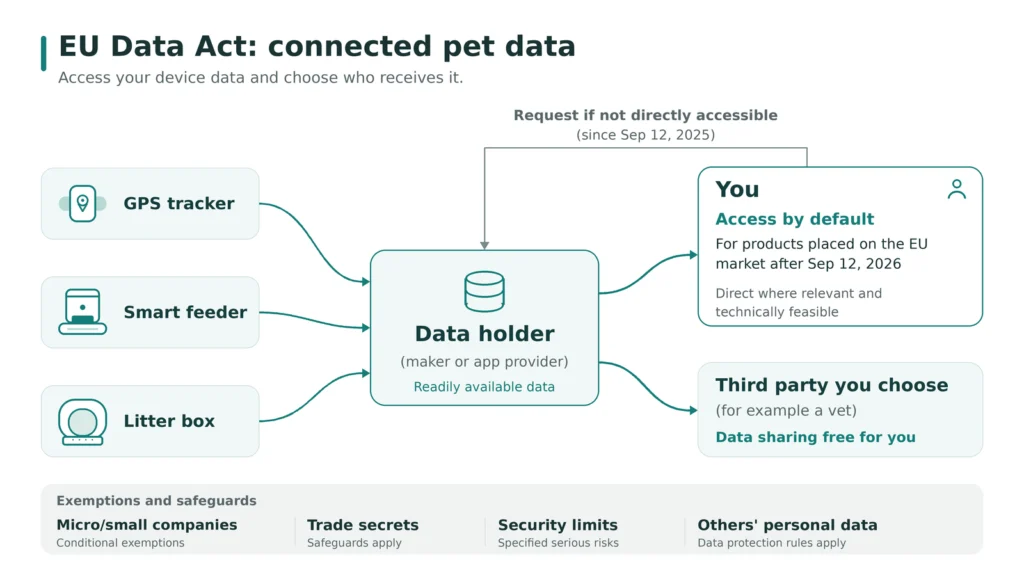
The Data Act is an EU regulation, adopted in December 2023. Most of it has applied since September 12, 2025. One key obligation was held back for a year. Article 3(1) requires makers to design connected products, and the services linked to them, so that the data is “by default, easily, securely, free of charge” accessible to the user. It also sets the format: “comprehensive, structured, commonly used and machine-readable.”
That design duty applies to connected products placed on the market after September 12, 2026. So the change is about how makers build and sell new devices, not a switch that flips on every feeder already in your home.
The request-based rights are older. Since September 12, 2025, you have been able to ask the data holder for data the device or app already holds, when you cannot reach it directly. You can also ask for it to go to a third party of your choice.
Why a pet tracker counts as a connected product
The law defines a connected product as an item that collects data about its use or environment and can communicate that data. A GPS collar, a camera feeder or a self-cleaning litter box does exactly that. The companion app usually counts as a “related service,” because the device cannot perform some of its functions without it.
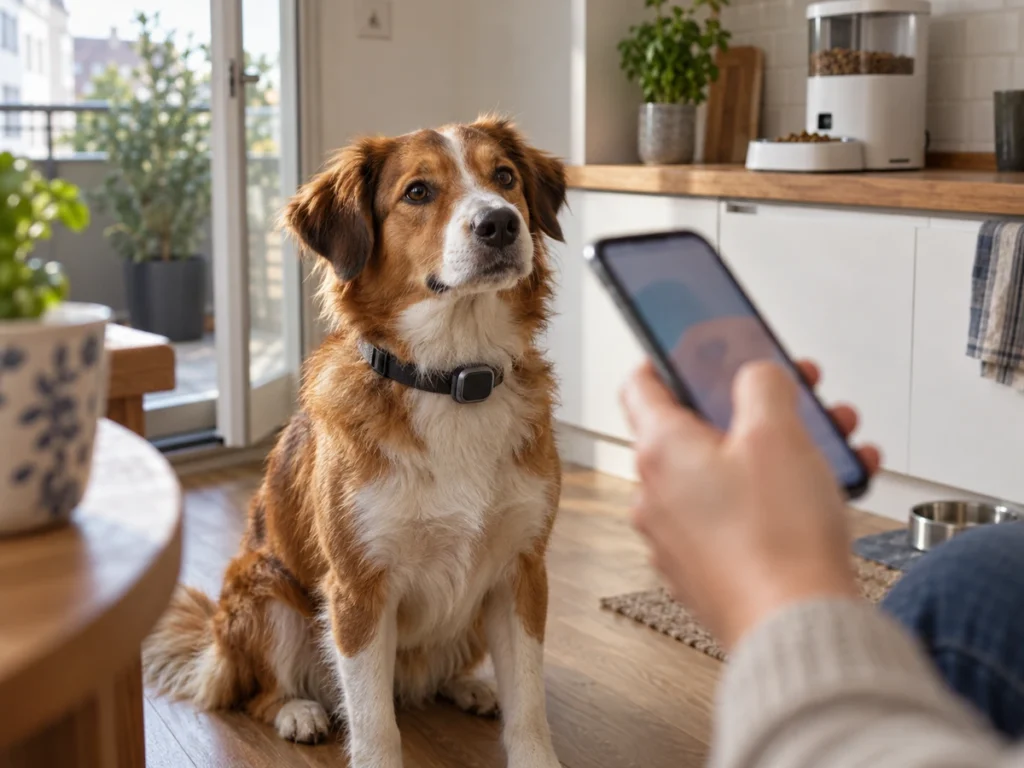
The law covers two kinds of data. Product data is what the device generates through use and was designed to make retrievable. Related service data records what you do in the app, or events linked to the device. For a tracker such as the Tractive DOG 6, which logs location, activity, sleep and scratching, that could include the history behind those charts. For a feeder, it could be the log of scheduled and dispensed meals. Which exact fields qualify depends on what the manufacturer designed the device to record, and the law leaves room for disputes at the edges.
What a seller must tell you before you buy
Article 3(2) sets out information the seller must give before the purchase contract. It covers:
- the type, format and estimated volume of data the device can generate
- whether it generates data continuously and in real time
- whether data is stored on the device or on a remote server, and for how long
- how you can access, retrieve or erase that data, and on what terms
The provider of the app or cloud service has its own list under Article 3(3). It must say whether it will use the data itself, and for what purposes. It must also say whether it plans to let third parties use it, and how you can complain to the national authority.
In practice, this gives you a way to compare two feeders or two trackers on something other than price. A product page that cannot say where its data lives, or how you get it out, now falls short of the rule.
How to get your pet’s data out
Start with the app. For new products, the law expects direct access to be the default where it is relevant and technically feasible. That could take the form of an export option in the app.
If you cannot reach the data directly, Article 4 lets you ask the data holder for it. The request should be simple and electronic where technically feasible. The data must come “without undue delay,” at the same quality the company has, and free of charge.
You can also ask for the data to go straight to someone else under Article 5. That could be a vet clinic’s software, a pet insurer or a rival app. The transfer must be free for you. Very large platforms designated as gatekeepers under the EU’s Digital Markets Act cannot be recipients through this route.
If a company refuses, you can complain to the competent authority your country designated under the Data Act, or use a certified dispute settlement body. You can also go to court.
The limits you should know about
The Data Act is not a blank check, and several exceptions matter for pet tech.
Small companies are exempt. The data-sharing chapter does not apply to products from microenterprises or small enterprises, as long as they are not linked to a larger group. Under the EU definition, a small enterprise has fewer than 50 staff and an annual turnover or balance sheet of no more than 10 million euros. That threshold is likely to cover some smaller pet-tech brands. Medium-sized companies get a one-year grace period in some cases.
Trade secrets can slow things down. A company can ask for confidentiality measures before sharing data it identifies as a trade secret. In exceptional cases, it can refuse, but it must justify that decision in writing and notify the authority.
Security can justify restrictions. A contract can limit access where sharing could undermine security requirements and seriously affect people’s health, safety or security.
Other people’s data needs a legal basis. If a tracker’s location history also reveals where a family member was, EU privacy law still applies to that personal data.
You cannot use the data to clone the product. The law bars you from using the data to build a competing device.
Do the rules help readers outside the EU?
Not directly. The Data Act governs products sold in the European Union. A buyer in the United States has no equivalent federal right to a device’s usage data. Some state privacy laws, such as California’s, give people a right to access their personal information, but they are built differently and do not set design rules for devices. Brands that sell in both regions may decide to offer the same export tools everywhere, but the law does not require it.
Even so, the checklist is useful anywhere. Before you buy a tracker, feeder or litter box, ask where the brand stores the data, how long it keeps it, and whether you can export it. A brand that answers clearly is easier to live with, and easier to leave.
The practical upshot
The EU Data Act for pet devices does not change the collar your dog wears today. It changes what new devices sold in the EU after September 12, 2026 must offer and what sellers must disclose. For owners, the useful habits are simple. Read the data information before you buy, look for an export option, and use your right to request the data or send it to a vet or another service. Just expect exemptions for smaller brands and some friction over trade secrets.