
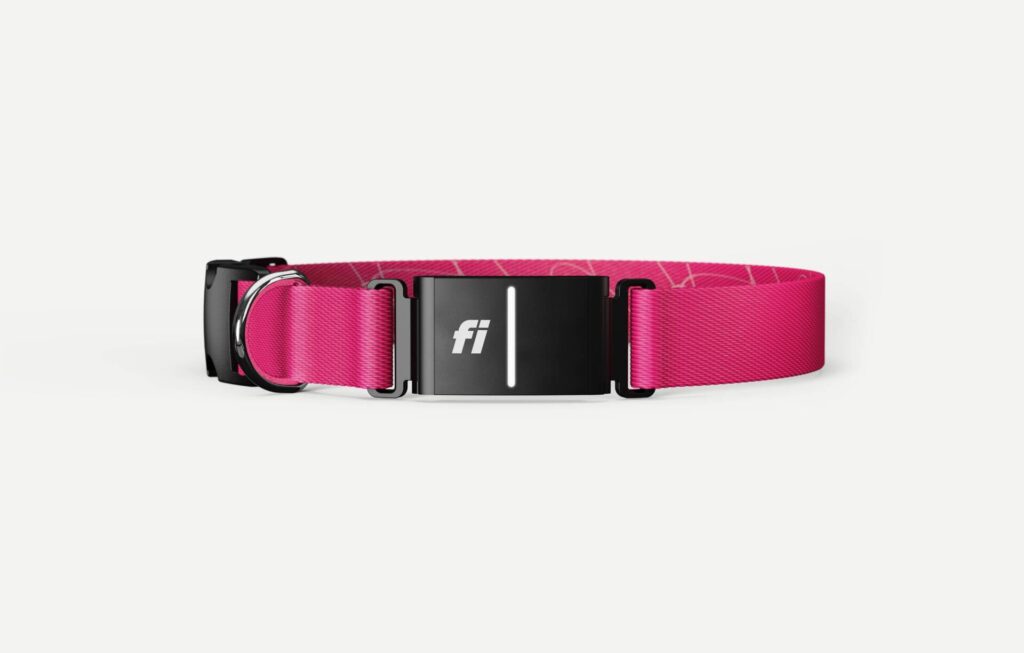
Fi Series 3+: Specs, Price, Pros & Cons
Fi's big idea is that a dog tracker should spend most of its life doing very little. The Series 3+ leans on a charging base at home and on the phones of everyone in the household, and only wakes its GPS and cellular radios when the dog is away from both. That is why Fi can quote battery life in months rather than days, and it is also the main thing to understand before buying one.
The tracker is built into Fi's own collar band: it locks into the band magnetically instead of clipping onto whatever collar the dog already wears, and the band comes in fixed sizes from toy breeds to giant ones. The 3+ updates the Series 3 and keeps its design. Fi's own comparison lists faster, more accurate GPS, AI behavior tracking (barking, licking, scratching, eating and drinking alongside steps and sleep) and Apple Watch support as the differences, and existing Fi bands and charging bases carry over.
The features that matter day to day are the escape alert when the dog leaves a safe zone, the Lost Dog mode that switches to rapid live updates, and the fact that every member of the household can share the app. The built-in light is a small but practical touch for evening walks.
What it gives up is flexibility. It is a dog product (Fi's cat option is the separate Fi Mini), and it only works with Fi's band. The battery estimate depends heavily on how much time the dog spends at home, so a dog that roams all day will see a fraction of the headline figure. And like every cellular tracker it needs a paid membership, with the device effectively bundled into it. For owners of an escape-prone dog who comes home every evening, those trade-offs are easy to accept.
Category strengths
Where the Fi Series 3+ beats the median
- Much longer battery life ?90 days vs 37 days (median)
Where the Fi Series 3+ trails the median
- No suitable for cats ?
How this VS Score was computed
Score 62: each known spec is measured against the median of all gps pet trackers (4 products), then weighted; 50 means level with that median. In classes of six or more, a value beyond the class’s 10th–90th percentile range counts as that limit, so one extreme product cannot set the scale. 24% of the scoreable weight could be used; unknown values, features not applicable to this class and proxies (battery capacity where a rated life exists) add or remove nothing.
| Specification | This product | Cohort median | Score weight | Points moved |
|---|---|---|---|---|
| Battery life | 90 | 37 | 1 | +50.0 |
| Suitable for cats | No | 50% of the class have it | 0.4 | −19.2 |
| Positioning systems | 1 | 1 | 0.6 | +0.0 |
| Connectivity | 3 | 3 | 0.5 | +0.0 |
Not scored: Live tracking (standard for the class (100% have it)); Update interval (unknown: not scored); Virtual fence (standard for the class (100% have it)); Escape alerts (standard for the class (100% have it)); International coverage (too few comparable peers (2, need 3)); Subscription required (standard for the class (100% have it)); Monthly fee from (unknown: not scored); Charging time (unknown: not scored); Replaceable battery (unknown: not scored); Weight (unknown: not scored); Waterproof (standard for the class (100% have it)); Find-at-night light (standard for the class (100% have it)); Sound beacon (unknown: not scored); Activity tracking (standard for the class (100% have it)); Sleep tracking (standard for the class (100% have it)); Health alerts (too few comparable peers (2, need 3)); Family sharing (standard for the class (100% have it)).
Editor’s note
I think the Series 3+ is the tracker to buy if your dog is mostly a homebody with a talent for escaping. The base-and-phone design means it barely uses its cellular radio while the dog is at home or with you, which is how Fi reaches an estimate of up to three months on a charge for a low-activity dog. Fi is candid that this falls to four to six weeks for a dog in and out of the yard all day, and to about two weeks for one that spends most of its time roaming away from home. A farm dog, a hunting dog or a hiking companion will live at the bottom of that range, and Lost Dog mode lasts about two days on a full battery.
The collar is the part I would think hardest about. Fi's band with its magnetic lock is built to take abuse (Fi quotes more than 220 kg of resistance and both IP68 and IP66K ratings), but it means the tracker cannot move to a harness or a favorite collar, and small dogs have to wear a band built around the device. For them, the Fi Mini is far lighter and attaches to most collars and harnesses.
The Tractive DOG 6 is the obvious comparison. It clips onto any collar, adds a sound beacon and lists support for more satellite systems, but its battery is measured in days rather than weeks because there is no home base doing the work. If charging every week or so sounds like a chore you will forget, Fi's approach is better.
The membership is not optional in practice: GPS location, escape alerts and history all sit behind it, and the device is sold bundled with a prepaid term. In the US, roaming covers Canada and Mexico, and Fi now also sells it in the UK and across Europe.
I would buy it for an escape artist that sleeps at home every night. For a dog that lives outdoors or travels constantly, I would look elsewhere.
Specifications
Quality bars show where each figure sits between the lowest and highest of the 4 gps pet trackers this VS Score is measured against.
Tracking
Battery
Design & durability
Health & activity
Sources and verification
Where the specifications come from
- Official product pageshop.fitracking.com
- Support and firmware documentationsupport.fitracking.com
- Independent testingtreelinereview.com
- Specification database (cross-check)support.fitracking.com
- Retailer listing (cross-check)amazon.com
Verification
- First published
- Specifications last checked
- Sheet completeness
- 17 of 23 specifications verified; the rest show as Unknown and are never estimated or scored
- Page type
- Product specification page — Compiled from the manufacturer’s published specifications and the cited sources; this is not a hands-on test.
- Basis
- Research-based: specifications and editorial text were compiled from the documents listed here and the manufacturer’s published data. We have not tested this unit ourselves; where independent measurements are mentioned they belong to the linked publication.
Where to buy
Prices and availability may change. Check the retailer before buying. We may earn a commission on purchases.
Price history
GPS Pet Trackers with similar specs to the Fi Series 3+
Ratings & reviews
No reviews yet. Be the first to share your experience.
The bottom line
The Fi Series 3+ earns a VS Score of 62 on the 24% of specifications we could compare like for like — an indication, not a ranking.
- Who it’s for
- Owners of escape-prone dogs that spend their nights at home, who want long gaps between charges and an alert the moment the dog leaves the yard.
- Who should look elsewhere
- Cat owners, owners of working or roaming dogs that are rarely near the base, and anyone who wants the tracker on their own collar or harness, since it only fits Fi's band.
- The trade-off that matters
- The long battery life depends on the dog being near the base or a family phone most of the time, and a dog that roams all day gets a fraction of it.
- The main alternative
- The Tractive DOG 6 clips onto any collar and adds a sound beacon, for owners who want that flexibility and do not mind charging far more often.
The VS Score is calculated from the weighted specifications above, each measured against the median of comparable gps pet trackers — a shortlisting guide, not a substitute for your own priorities. See how we score.