
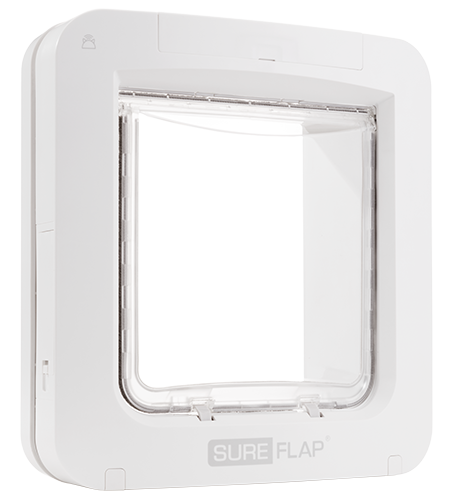
SureFlap Microchip Pet Door Connect: Specs, Pros & Cons
The word "Connect" in this product's name refers to a second box that is not in the carton. Without the Sure Petcare Hub, which plugs into a spare port on your router and is sold separately, this is SureFlap's standard Microchip Pet Door: a battery-powered flap that unlocks for registered animals and ignores everyone else's. With the Hub, the same door starts reporting to your phone, and that reporting is most of what you are paying extra for.
Physically it is SureFlap's larger door, sized for big cats and small dogs rather than for anything a Labrador owner would recognize as a dog flap. It reads the microchip your vet already implanted, or the RFID collar tag packed in the box for an animal that has none, so there is nothing new for most pets to wear. It fits into doors, walls and glass, but a glass installation needs a new pre-cut pane and SureFlap's mounting adaptor, and a door with metal in it also needs accessories, so the fitting bill can be larger than the door's own.
The features that earn their place day to day are modest ones: a notification when a pet comes in or goes out, a history that makes a change in routine visible, and the ability to lock the flap from work before a storm or a vet appointment. The curfew and the locking modes do the rest, and they work from the buttons on the door as well as from the app.
The limit to understand before reading further is which way the reader faces. It sits on the outside only, so the door decides who may come in, never who may leave. Every animal in the house can walk out whenever the flap is unlocked for exit. That is irrelevant to a household keeping out the neighbor's cat, and it rules this door out for one that needs a particular pet kept indoors while another roams.
How this VS Score was computed
Score 0: each known spec is measured against the median of all smart pet doors (1 products), then weighted; 50 means level with that median. In classes of six or more, a value beyond the class’s 10th–90th percentile range counts as that limit, so one extreme product cannot set the scale. 0% of the scoreable weight could be used; unknown values, features not applicable to this class and proxies (battery capacity where a rated life exists) add or remove nothing.
Not scored: Microchip recognition (too few comparable peers (1, need 3)); RFID collar tag (too few comparable peers (1, need 3)); Registered pets (too few comparable peers (1, need 3)); Curfew mode (too few comparable peers (1, need 3)); Selective entry / exit (too few comparable peers (1, need 3)); Locking modes (too few comparable peers (1, need 3)); App control (too few comparable peers (1, need 3)); Activity log (too few comparable peers (1, need 3)); Hub required (too few comparable peers (1, need 3)); Voice assistant (unknown: not scored); Flap opening width (unknown: not scored); Flap opening height (unknown: not scored); Max pet size (too few comparable peers (1, need 3)); Installation surfaces (too few comparable peers (1, need 3)); Battery life (too few comparable peers (1, need 3)); Low-battery alert (too few comparable peers (1, need 3)); Draught excluder (too few comparable peers (1, need 3)).
Editor’s note
I think this door is easy to recommend for exactly one kind of household and quietly frustrating for another, and the difference has nothing to do with its build.
If your problem is intruders, it does what you want. A neighbor's tom that walks in, eats and sprays is the classic reason people buy a microchip door, and this one only opens for chips it has been taught, holding up to 32 animals in memory. Reading existing implants rather than relying on a collar key matters more than it sounds: collars get lost, and a door keyed to a lost tag is a locked door.
Where it frustrates is the multi-pet home with different rules. Say one cat is recovering from surgery, or a new kitten must stay in for its first weeks. This door can lock exit for everybody, but it cannot keep one animal in while another comes and goes, because the reader only checks arrivals. SureFlap's own Microchip Cat Flap Connect can, using a scanner on both sides, but it is a cat flap with a smaller opening, so a small dog is back to this model and its limits.
The Hub is the other thing to weigh. It needs an Ethernet port on your router, and Sure Petcare advises keeping it within about 10 meters of the door and preferably in line of sight, so a door at the far end of a house with thick walls may need a powerline adapter as well. If the app history is not something you would look at, the plain Microchip Pet Door gives you the same locking without the second purchase.
On running costs, it uses four C cells, a size fewer households keep in a drawer, and Sure Petcare quotes up to six months per set. The maker also publishes inconsistent flap-opening figures between its US page, its UK page and its Amazon listing, so measure your pet against the door itself before cutting a hole in anything.
Specifications
Access control
Smart features
Fit & installation
Power & weatherproofing
Sources and verification
Where the specifications come from
- Official product pagesurepetcare.com
- Datasheet or manualmedia.surepetcare.com
- Support and firmware documentationplay.google.com
- Retailer listing (cross-check)amazon.com
Verification
- First published
- Specifications last checked
- Sheet completeness
- 15 of 19 specifications verified; the rest show as Unknown and are never estimated or scored
- Page type
- Product specification page — Compiled from the manufacturer’s published specifications and the cited sources; this is not a hands-on test.
- Basis
- Research-based: specifications and editorial text were compiled from the documents listed here and the manufacturer’s published data. We have not tested this unit ourselves; where independent measurements are mentioned they belong to the linked publication.
Where to buy
Prices and availability may change. Check the retailer before buying. We may earn a commission on purchases.
Price history
Ratings & reviews
No reviews yet. Be the first to share your experience.
The bottom line
- Who it’s for
- A home with cats or a small dog that is being raided by a neighbor's animal and wants a log of comings and goings on the phone, with a spare router port for the Hub.
- Who should look elsewhere
- Anyone who needs to keep one specific pet indoors while others roam, or a dog owner whose dog is bigger than a large cat. Look elsewhere in both cases.
- The trade-off that matters
- It checks identity only on the way in, so exit control is all-or-nothing, which becomes a real nuisance the first time one pet has to stay home.
- The main alternative
- SureFlap Microchip Cat Flap Connect, if every animal is a cat and you want per-pet exit permissions from its two-sided scanner.
The VS Score is calculated from the weighted specifications above, each measured against the median of comparable smart pet doors — a shortlisting guide, not a substitute for your own priorities. See how we score.