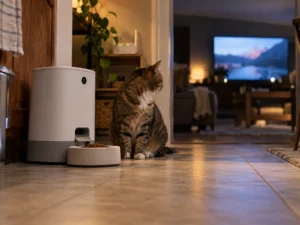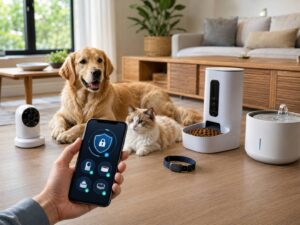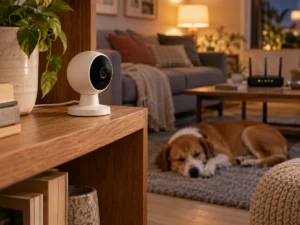
A federal security label for smart home gear is close enough now to change how you shop, and most connected pet products sit inside its scope. The U.S. Cyber Trust Mark is a voluntary Federal Communications Commission program for wireless consumer Internet of Things products. On August 11, 2026, the FCC opened the filing window for the organizations that will approve labels, which is the last big administrative step before products can be submitted. No pet camera carries the mark yet. Still, the registry behind that label is built to publish the two facts pet owners almost never get in advance, so it is worth understanding before your next purchase.
Which pet devices the program covers
The FCC scopes the program to wireless IoT products for the home and lists examples of what qualifies. Those examples include internet-connected home security cameras, smart appliances, voice-activated shopping devices, fitness trackers, garage door openers and baby monitors.
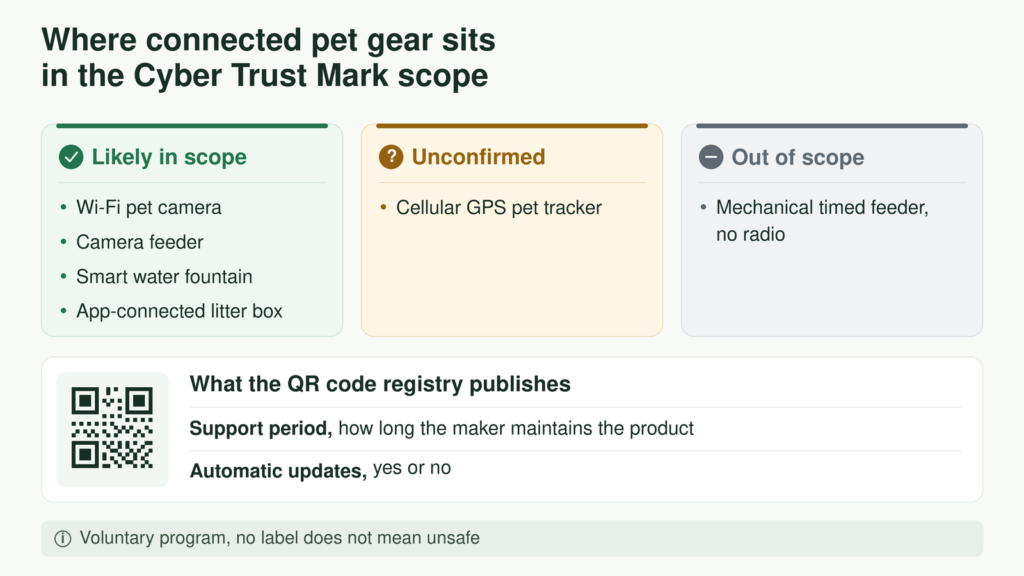
Pet products are not named in that list. Reading the categories across, though, a Wi-Fi pet camera, a camera feeder, a smart fountain and an app-connected litter box all belong to the same families the FCC describes. That reading is an interpretation of the published scope. The Commission has not ruled on it, and it has not published a pet-specific category.
Two edge cases deserve care. Cellular GPS pet trackers connect over a mobile network, and the program has not said whether it treats them as eligible. A purely mechanical timed feeder with no radio falls outside, because the FCC excludes wired devices and the program is built around wireless products.
What the label will publish
The mark itself is a logo, and the logo is the least interesting part. Beside it sits a QR code. Scanning that code takes you to a registry entry written in plain language about that specific product.
Two entries in that record matter more than anything else for pet gear. The first is the support period, meaning how long the manufacturer commits to maintaining the product. The second is whether security patches and software updates install automatically or wait for you to act.
Pet gear makes both of those matter more than usual. Feeders and litter boxes are bought once and then left running for years, often in a spare room where nobody looks at it. A camera watching a living room keeps recording long after the maker has moved on to a newer model. A published end-of-support date turns that silent risk into a number you can compare across products.
How the program works behind the label
The FCC owns the program but does not run it alone. A Lead Administrator recommends the technical standards, the testing procedures and the label design. Cybersecurity Label Administrators review manufacturer applications and decide whether to grant use of the mark. Accredited labs known as CyberLABs perform the testing. Every one of those bodies must be accredited against international ISO and IEC standards, and the technical requirements draw largely on criteria from the National Institute of Standards and Technology.
The path to here has been long. The FCC proposed the scheme in August 2023 and adopted the framework rules in March 2024. UL Solutions withdrew as Lead Administrator effective December 19, 2025, and the ioXt Alliance took the role effective April 13, 2026. The August 11, 2026 filing window covers the Label Administrators.
Manufacturers still cannot apply. Standards for at least one product class must be recommended, opened for public comment and adopted by order, and the administrators and labs must then be accredited to that scope. The FCC has said it will announce when applications open, and it has not given a date.
Why a missing label will not mean much
Participation is optional and it costs money, because testing happens at an accredited lab at the manufacturer’s expense. Small pet tech brands may reasonably skip it. So an unlabelled feeder is not evidence of a bad product, and the mark’s absence proves nothing on its own.
That cuts the other way too. A label confirms that a product met a baseline at the time of testing. It does not promise the company will still exist in four years, nor that a cloud service behind the device will keep running. Anyone treating the mark as a guarantee of long-term service will be disappointed.
What to ask a pet tech brand today
You can demand the same disclosures now, before any label exists. Put these questions to the seller or the support team in writing, and keep the answer.
- Until what date will this model receive security updates?
- Do firmware updates install automatically, or must I approve each one?
- Which functions stop working if the company shuts down its servers?
- Is a subscription required for any safety-critical feature, such as camera alerts?
- Where is video or location data stored, and for how long?
Product specifications answer part of this. Our record for the PETLIBRO Granary Smart Camera Feeder Dual Bowl sets out how the camera, app and hardware fit together, which tells you how much of the device depends on a live connection before you ever reach the support questions.
Where this leaves buyers
The Cyber Trust Mark is real, funded and moving, but it is not yet on a shelf. Through the rest of 2026 you will still be buying pet devices without it, so the burden of asking stays with you. When labeled products do arrive, scan the code rather than trusting the logo. The support date and the update behavior are the answers worth having, and a brand willing to publish them today deserves more confidence than one that will not.