PetTechScout compares pet tech side by side: full specifications, weighted VS Scores and live retailer prices, with a published methodology and no pay-to-rank.
Review · Litter Boxes
Litter-Robot 4 Review: The Mature Choice Now That the Litter-Robot 5 Has Arrived
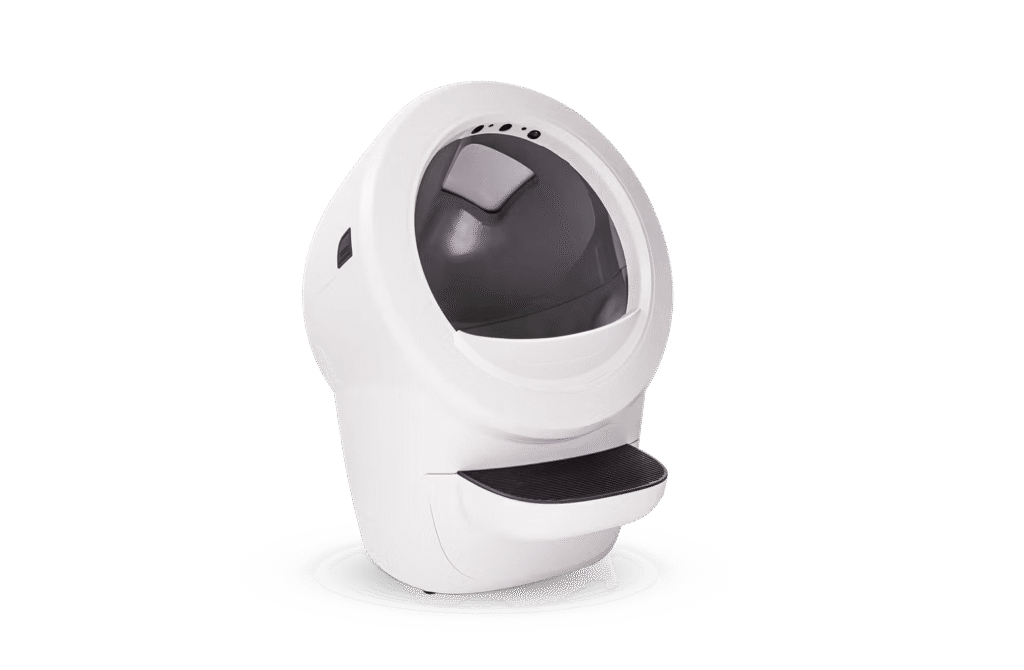
Whisker launched the Litter-Robot 4 in 2022 and has kept it on sale after releasing the Litter-Robot 5. The older model did not get retired, it got repositioned as the cheaper of the two flagship boxes, with several years of firmware and app work behind it.
That history matters more than the spec sheet. A self-cleaning litter box is a motorized machine that a cat climbs inside every day, so the questions worth asking are whether the sifting mechanism jams, whether the sensors reliably notice a cat, and whether the company fixed the faults owners reported. All three can be checked against published evidence.
Nobody on this team has run a Litter-Robot 4 at home. Every factual claim below comes from Whisker's own manual and support pages, or from reviewers who documented the testing they carried out themselves, and each is attributed where it appears.
Affiliate disclosure: the price links on this page may earn us a commission at no extra cost to you. Retailers cannot pay for placement or influence the score. How we stay independent
Editorial ratingExcellentWeighted average of 6 rated sections.
A mature self-cleaning box with a sifting mechanism that reviewers found reliable and a sealed waste drawer, held back by a globe that is tight for large cats and a radio that only speaks 2.4 GHz.
Strengths
The rotating sifting mechanism has no rake and no wires inside the globe, and independent testers who used it for months reported consistent cycling without jamming
A sealed waste drawer with a carbon filter above it, which testers found kept odor contained unless the drawer was open
Two detection methods, weight sensors plus laser curtain sensors, backed by documented anti-pinch and overload behavior
Weaknesses
The globe is about an inch smaller inside than the Litter-Robot 3, and large cats have been reported to find it cramped
Wi-Fi works on the older band only, and Whisker's own support article documents mesh routers steering the unit onto the newer band and breaking the connection
Only clumping litter, or crystals small enough to pass the screen, will work. Tofu, wood pellet and non-clumping litters are ruled out
Research-based: assessed from the manufacturer’s published specifications, documentation and the independent sources listed at the end. We have not tested this unit ourselves; any measurement quoted belongs to the cited source.
Method
Every physical measurement and operating rule in this review comes from the official Litter-Robot 4 instruction manual or from Whisker's support articles, both of which are linked in the sources list. Performance judgments come from reviewers who documented the testing they carried out themselves, principally Cats.com, whose team reported months of in-home use across several households and published measurements. Retailer ranking evidence was read directly from the Amazon Best Sellers listing and recorded with the time it was retrieved. Manufacturer claims and independent observations are kept separate throughout, and each section score is justified against the evidence available for that specific area.
Evidence
Whisker publishes a 40 page multilingual manual with a full dimensions table, safety rules and a description of the cleaning cycle, plus support articles covering network requirements and onboarding faults. Cats.com published a dedicated Litter-Robot 4 review, last updated October 3, 2025, based on a beta unit tested for three weeks before launch and ongoing in-home testing by several team members, and a category roundup last updated September 9, 2026 covering 38 models. The Amazon Best Sellers list for Self-Cleaning Cat Litter Boxes placed Whisker's Litter-Robot 4 bundle at rank 6 when retrieved on September 16, 2026 at 13:05 UTC.
Limitations
No unit was operated by this site, so nothing here is an observation made by this team. Whisker does not publish a waste drawer volume, a cleaning cycle duration or a noise rating, so those values are absent from the specification record, with no estimate in their place. The cycling noise figure quoted in the review is a third-party measurement and the source article is internally inconsistent about it, which is stated in the text. Amazon's ranking reflects one retailer on one day and does not measure units sold across the market. A check of published recall notices did not surface a Litter-Robot recall, which is not the same as confirming that none exists.
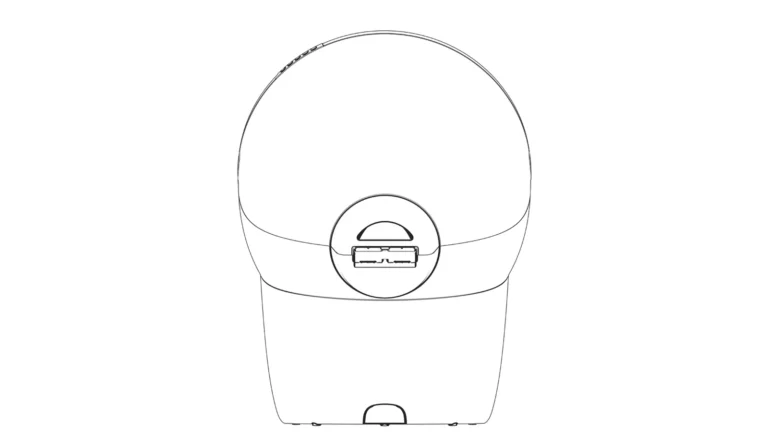
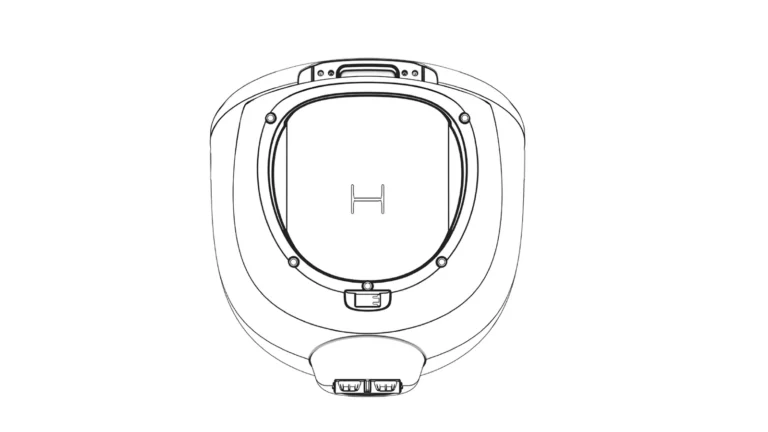
Rear view from the official Litter-Robot 4 manual. The globe sits above the base, and the power inlet is the only connection on the unit. Whisker Litter-Robot 4 instruction manual, official technical diagram
The Litter-Robot 4 is a globe on a pedestal. The upper sphere holds the litter and rotates to sift, the base holds the waste drawer, the electronics and the weight sensors. Nothing electrical sits inside the globe, which is the reason Whisker can state in the Litter-Robot 4 manual that there are no rakes or wires where the cat stands.
The published footprint is 22 by 27 inches, or 56 by 68.6 centimeters, and the unit stands 29.5 inches tall at 75 centimeters. Empty, it weighs 24 pounds, about 10.9 kilograms. Those numbers are worth measuring against a real corner before ordering, because the manual adds a rule that is easy to miss. The unit must not touch a wall on any side, since contact throws off the weight sensors that detect the cat. A box that fits the floor space may still not fit the clearance requirement.
Surface matters for the same reason. Whisker specifies a firm, level floor and sells a carpet tray for homes where that is not possible, stating that the weight readings are most accurate off carpet. The entryway is a circular opening measured at 15.75 by 15.75 inches, or 40 by 40 centimeters, and the step up from the floor to that opening is 30.5 centimeters. For an older cat or one with joint trouble, that climb is the single most important number in the table, and Whisker sells a ramp for it.
Build quality reads well in independent hands. Cats.com's testers, who have run the unit across several households, listed good build quality and an effective design among the things they liked, alongside the availability of published replacement parts and repair guides.
How the cleaning cycle works
9.0/10Exceptional
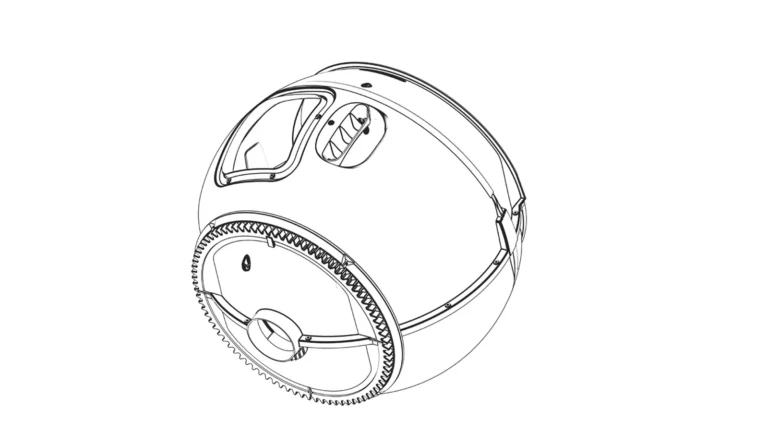
Globe seen from behind in the official manual. The toothed gear track around the rim drives the rotation, and waste leaves through the opening at the center. Whisker Litter-Robot 4 instruction manual, official technical diagram
The globe rotates counterclockwise after the cat leaves. A flexible liner inside falls away from the wall as the globe turns upside down, clumps drop through a screen into the waste port, and the globe then rotates back so the clean litter spills into place. Before it settles, it rotates past the home position once to level the bed. That sequence is set out step by step in the manual, and it explains why there is no rake to jam.
The delay before a cycle starts is adjustable from 3 to 30 minutes, with 7 minutes as the figure Whisker uses in its own guidance for waste to clump. If the cat re-enters during the countdown, the sensors restart it.
On how well that works in practice, the most useful evidence comes from Cats.com's long-running test, whose testers used the box for months with clumping clay litter. They reported that the rotating sifting mechanism does not tend to jam the way rake-based boxes do, that cycles ran consistently whether triggered automatically, by the panel button or from the app, and that clumps separated without much residue or sticking.
The constraint is litter type. Whisker specifies clumping litter, or beads and crystals small enough to fall through the screen, and rules out strictly absorbent, non-clumping, loose-clumping, newspaper and wood pellet products. Lightweight corn and wheat litters may not pass the screen properly. Cats.com puts it more bluntly for one popular category, noting that tofu litter will not work. Anyone committed to a plant-based litter should treat that as disqualifying.
Odor control and the waste drawer
8.5/10Excellent
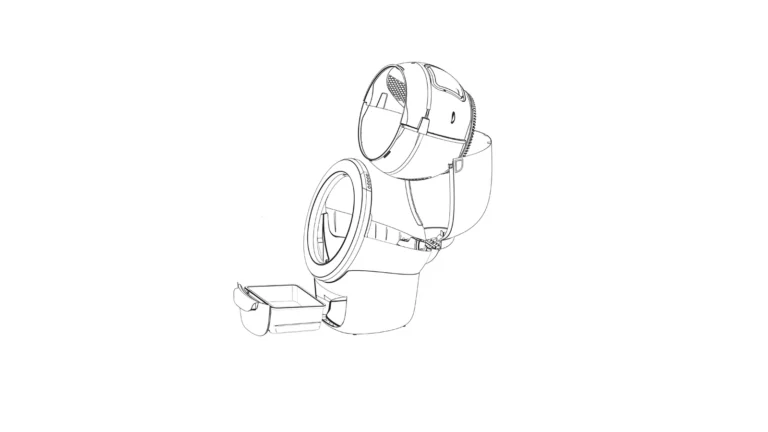
Exploded view from the official manual. The waste drawer slides out of the base, which is the part an owner handles weekly. Whisker Litter-Robot 4 instruction manual, official technical diagram
Waste falls into a drawer in the base that measures 5.5 by 13.5 by 9.25 inches, or 14 by 34.3 by 23.5 centimeters. Whisker does not publish a volume for it, so the manual instead gives a practical figure: the drawer takes a standard bin liner of 37 to 49 liters, and the company recommends changing it weekly for one cat and twice weekly for two.
Odor control rests on two things working together. The drawer seals, and a carbon filter sits above it, with optional scented packs available in place of the filter. The sealing is what does the work. Cats.com's testers reported that they did not notice litter box odor unless the drawer was open, and that smells were otherwise contained.
The drawer on the 4 is smaller than the one on the Litter-Robot 3, which sounds like a downgrade and mostly is not. The same testers found waste collected more evenly in it, dropping towards the center instead of piling against one side, so more of the volume gets used. They also noted the fullness sensor is more sensitive than the older model's, to the point that the tray filled right to the top before a notification appeared. If the app is your only prompt to empty it, you may be emptying a very full drawer.
One historical fault belongs here. Cats.com reports that the original fence attaching to the front of the unit allowed urine to leak through a gap between the globe and the base. Whisker released an improved fence and a bezel guard for owners who prefer not to use the fence, and corrected the design on the Litter-Robot 5. Anyone buying a used unit should check which fence came with it.
Safety, sensors and the cats it suits
8.5/10Excellent
Underside of the base in the official manual. The cat sensor and weight scale live here, which is why the manual insists on a firm, level floor and no contact with walls. Whisker Litter-Robot 4 instruction manual, official technical diagram
Whisker calls the detection system OmniSense, and it combines two different methods. Weight sensors in the base register a cat standing in the globe, and laser curtain sensors across the opening catch a cat that peeks in or steps in without putting enough weight down. Cats.com describes that pairing as the reason the 4 was the safest Litter-Robot to date, since the older model relied on weight alone.
If a curtain sensor triggers during a cycle, the globe stops, and the manual states it waits 15 seconds after the cat leaves before resuming. Two anti-pinch safety features and an overload detection system cover the case where the globe jams or meets resistance. These are documented behaviors with described light-bar signals, and the manual is specific enough that an owner can tell a safety stop from a fault.
The cat side has two hard limits. Automatic mode needs a cat of at least 3 pounds, about 1.36 kilograms, because the weight scale will not register anything lighter. Whisker's own answer for kittens below that is to run the box unplugged and power it on manually after use, which works but defeats the point of an automatic box. At the other end Whisker states there is no weight limit, and points to the 15.75 inch entryway and the 15 to 17 inch interior height as evidence that almost any domestic cat fits.
That claim deserves a caveat, and the independent evidence supplies it. The globe on the 4 is about an inch smaller inside than on the Litter-Robot 3, and Cats.com reports that some owners find the interior cramped for large cats and lists the smaller litter bed among the things it did not like. No weight limit is not the same as comfortable for a large cat, and a Maine Coon owner should treat the 90 day home trial as the actual test.
The app, the Wi-Fi limit and what it costs to run
7.0/10Good
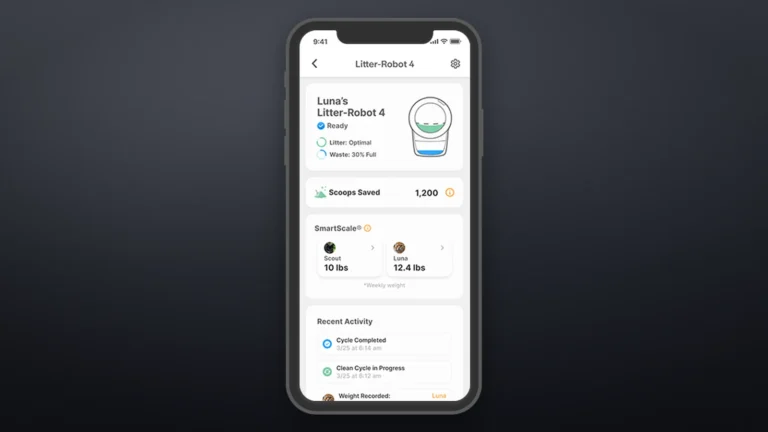
Whisker's own published app screenshot for the Litter-Robot 4. The SmartScale card is the part that turns the box into a passive weight record. Whisker app screenshot published by Whisker
The Whisker app shows litter level, waste drawer level, per-cat weight from the SmartScale and a running activity log of cycles and visits. It needs iOS 13 or Android 8 as a minimum, and several people in a household can use the same account. For a multi-cat home the weight history is the feature with real value, because a cat quietly losing weight is something an owner rarely notices and a scale under the litter box records every few days without anyone remembering to do it.
The connectivity limit is the part to check before buying. Whisker states that the Litter-Robot 4 requires a 2.4 GHz network and does not support 5 GHz. Its support article on onboarding failures goes further, warning that mesh routers combining both bands can steer the unit onto the faster band after a successful setup, at which point it disconnects and will not come back. The documented workaround is a dedicated guest network on the older band, and the same article asks owners to confirm that ports 443 and 8443 are open. That is more network administration than a litter box should need, and on a modern mesh system it is a realistic source of frustration.
A disconnected box still cleans. The cycle logic runs on the unit, and the panel buttons work regardless. What stops is the remote view, the alerts and the weight history, which is the same pattern across this category and one we have looked at in detail in what actually keeps working when a smart feeder or litter box goes offline.
Running costs are modest and mostly optional. Carbon filters and drawer liners are consumables, though the manual permits any 37 to 49 liter bin liner in place of branded ones. The warranty is WhiskerCare for one year, with a three year plan sold separately. The direction of travel is worth watching: Whisker's newest hardware ties some insight features to a paid Whisker plus membership, while the Litter-Robot 4's app functions do not require one today. Since the box sits on your home network and logs your cat's habits, it is also a reasonable candidate for our checklist for securing a smart pet device.
Value beside the Litter-Robot 5
7.0/10Good
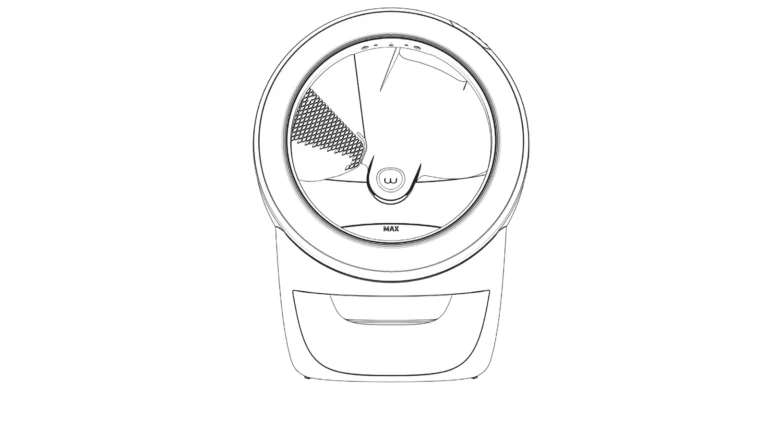
Front view from the official manual, with the screen inside the globe and the MAX fill line marked below the opening. Whisker Litter-Robot 4 instruction manual, official technical diagram
Whisker now sells four Litter-Robots: the 5 Pro, the 5, the 4 and the smaller EVO. The Litter-Robot 5 is built on the same footprint as the 4 and adds WasteID, which Whisker says distinguishes solid from liquid waste, an updated scale, and support for up to five cats between 3 and 30 pounds. The 4 is rated for up to four cats. Whisker dropped the price of the 4 when the 5 launched, and the gap between them is the whole question.
Cats.com's 2026 roundup of 38 models ranks the Litter-Robot 5 Pro first and the Litter-Robot 4 second, describing the 4 as having years of software patches behind it and calling it one of the most reliable automatic litter boxes on the market. That ordering is the useful signal. The newer model is better, the older one is the safer bet on maturity.
That maturity is not a slogan. Cats.com reports that sensor malfunctions were fairly common in the months after the 4 launched and have since been addressed through firmware and app updates. A buyer today gets the version that came out of four years of that work, while the 5 is at the start of its own cycle. The 5 Pro is also the first model designed around Whisker's paid membership, which is a different ownership proposition.
Outside Whisker's range, the honest comparison set for a buyer who balks at the price is narrower than the search results suggest. Cats.com's budget pick in the same roundup is the PetSafe ScoopFree SmartSpin, and the highest-ranking non-Whisker smart box in Amazon's self-cleaning category on the day this review was researched was the PETKIT PuraMax 2. Neither has been assessed on this site yet, so treat those as leads for now.
Where to buy
We have no current, in-stock price for the Litter-Robot 4 from the retailers we track. The links below go to the listings we last saw; the price shown there may have changed.
No retailer listing is on record for this exact model at the moment.
Prices and availability come from retailer feeds and change without notice; the retailer’s page is authoritative. We may earn a commission if you buy through these links.
Scores run from 1.0 to 10.0: 9+ exceptional, 8–8.9 excellent, 7–7.9 good, 6–6.9 fair, 5–5.9 mediocre, below 5 poor. The overall score is the weighted average of the rated sections. Unrated sections do not count.
Pros
The rotating sifting mechanism has no rake and no wires inside the globe, and independent testers who used it for months reported consistent cycling without jamming
A sealed waste drawer with a carbon filter above it, which testers found kept odor contained unless the drawer was open
Two detection methods, weight sensors plus laser curtain sensors, backed by documented anti-pinch and overload behavior
Per-cat weight logging that builds a passive health record in a multi-cat home
Four years of firmware and app work behind it, with the early sensor complaints documented as addressed, plus a published manual, replacement parts, repair guides and an improved fence for the original leak issue
Cons
The globe is about an inch smaller inside than the Litter-Robot 3, and large cats have been reported to find it cramped
Wi-Fi works on the older band only, and Whisker's own support article documents mesh routers steering the unit onto the newer band and breaking the connection
Only clumping litter, or crystals small enough to pass the screen, will work. Tofu, wood pellet and non-clumping litters are ruled out
Automatic mode ignores cats under 3 pounds, so kitten households run it manually until the kitten grows
Fullness alert reportedly fires only once the drawer is already full
Litter-Robot 5 gets the corrected fence design, the updated scale and a higher rated cat count on the same footprint
Conclusion
The Litter-Robot 4 is the version of this product that has already been debugged in public. The mechanism is simple enough to be reliable, the safety systems are documented in detail, and the faults owners found after launch have traceable fixes behind them. For a machine that a cat has to trust every day, that history is worth more than a new feature list.
Two things should decide it. Measure your cat, because the globe is smaller inside than the previous generation and large cats have been reported to find it tight. Then check your router, because a box that only speaks 2.4 GHz on a band-steering mesh network is a support ticket waiting to happen. If both check out, the gap to the Litter-Robot 5 is a question of budget.
Andreea-Viviana Jitaru’s take
Reading Whisker's documentation next to four years of owner complaints leaves a clear impression: this is a company that keeps fixing things, and that publishes enough detail for an owner to tell a safety stop from a fault. That is rarer in pet tech than it should be, and it is most of the reason the Litter-Robot 4 still holds a recommendation next to its own replacement. The part that gives me pause is not the hardware. It is the direction shown by the newest model, where insight features attach to a paid membership. The 4 predates that, and buyers who dislike subscriptions may find the older box is the one that stays useful on their terms.
Buy it if
Multi-cat homes that would use per-cat weight history as an early health signal
Average-sized cats on clumping clay litter
Buyers who value a documented repair path and four years of firmware fixes over the newest hardware
Homes with a stable network on the older Wi-Fi band, or a router that can split one off as a guest network
Consider an alternative if
Your cat is large enough that a slightly smaller globe would matter, such as a Maine Coon
Tofu, wood pellet or non-clumping litter you will not give up
Your only network is a mesh system that steers devices between bands and cannot be split
A kitten under 3 pounds, if you want automatic cleaning from day one
You want the Litter-Robot 5's newer sensors and can pay more
Does the Litter-Robot 4 work without an internet connection?
The cleaning cycle runs on the unit itself, so it keeps sifting and the panel buttons keep working when the connection drops. What stops is remote control, alerts, the litter and waste readouts and the weight history, all of which need the app.
Will it connect to a 5 GHz network?
No. Whisker states that the Litter-Robot 4 requires a 2.4 GHz signal and does not support the faster band. On a mesh router that combines both bands, Whisker's support article recommends a dedicated guest network on that band, because band steering can disconnect the unit after a successful setup.
Can kittens use it?
Kittens can use the globe, but the scale will not register a cat under 3 pounds, so automatic mode will not trigger. Whisker's own guidance is to leave the unit powered off and run a cycle manually after use until the kitten is heavy enough.
What litter does it need?
Clumping litter, or beads and crystals small enough to fall through the screen. Whisker rules out strictly absorbent, non-clumping, loose-clumping, newspaper and wood pellet litters, and notes that lightweight corn and wheat products may not pass the screen properly.
How often does the waste drawer need emptying?
Whisker recommends changing the drawer liner weekly for one cat and twice weekly for two. The drawer takes a standard 37 to 49 liter bin liner, so branded liners are optional.
Is it still worth buying now that the Litter-Robot 5 exists?
For most buyers, yes. Cats.com ranks the Litter-Robot 5 Pro first and the Litter-Robot 4 second in its 2026 roundup, describing the 4 as one of the most reliable automatic litter boxes on the market after years of software patches. The 5 has the corrected fence design and an updated scale, so buyers without a budget constraint have a reason to spend more.
Andreea edits the written side of the site: the editor's note on each product page, the category buying guides and the blog. Her brief is to say what a specification table cannot: where a product is good, where it quietly compromises, and who should walk past it. A note that reads like marketing copy, or that praises a product without naming a drawback, does not go live.
This is a research-based assessment: the reviewer compiled it from published specifications, documentation and independent measurements rather than from testing the unit.
We keep cookies to a minimum. The only ones this site sets are the ones it needs to work: remembering your answer here, keeping the site secure, and signing you in if you choose to post a review. We run no advertising cookies, and we measure traffic without cookies at all.Cookie policy
Customise consent preferences
Each category below lists the exact cookies behind it, what they do and how long they last. Strictly necessary cookies cannot be switched off because the site would stop working without them. Anything else is yours to decline.
NecessaryAlways active
Strictly necessary cookies keep the site working and secure: they remember your choice here, protect forms from abuse and keep you signed in to the admin area. The site cannot run without them.
Show the cookies in this category (9)
cmp_consent
PetTechScout · 1 year
Remembers your consent choice for each cookie category, so the banner does not ask again on every page.
cmp_visitor
PetTechScout · Session (until you close the browser)
Marks your browser as a real visitor, so a comparison page is built when someone actually opens one rather than when a crawler passes through. It holds the value 1 and nothing else: no identifier, no history.
__cf_bm
Cloudflare · 30 minutes
Tells automated traffic from real visitors at the security layer that sits in front of this site. It holds a bot score, not an identity, and is not used for advertising.
cf_clearance
Cloudflare · Set by Cloudflare (typically 30 minutes)
Records that your browser passed a security check, so you are not challenged again on every page. Set only if a check was shown to you.
wp-settings-(id), wp-settings-time-(id)
WordPress · 1 year
Remembers layout preferences inside the WordPress admin screens. Set only for accounts that sign in to run the site, never for ordinary visitors.
wfwaf-authcookie-(hash)
Wordfence (Defiant, Inc.) · 12 hours
Lets the Wordfence firewall check a signed-in user’s access level before WordPress loads, so administrators are not blocked by firewall rules. Set only when you log in to the site.
wf_loginalerted_(hash)
Wordfence (Defiant, Inc.) · Persistent
Records that the administrator has already been alerted about a sign-in from this device. Only used if login alerts are enabled, and set only when you log in to the site.
wfCBLBypass
Wordfence (Defiant, Inc.) · Only if enabled
Allows a visitor who knows a hidden bypass address to pass country blocking. It is only used if country blocking is enabled, and we do not currently use it.
wfls-remembered-(hash)
Wordfence (Defiant, Inc.) · Up to 30 days
Remembers a trusted browser for two-factor login when a signed-in user chooses “remember this device”. Set only for site accounts that use two-factor authentication.
Functional
Functional cookies are set only when you choose a feature that needs them, such as signing in with Google to post a review. Decline and the rest of the site works exactly as before. Only that button stops working.
Show the cookies in this category (1)
g_state (and Google’s own sign-in cookies)
Google · Set by Google
Set only if you use the Google sign-in button to post a review. It remembers the state of that prompt so it is not shown again. Governed by Google’s own policy.
Set by other sites
These are set on a retailer’s own website after you click through to it, so they are governed by that site rather than by this banner.
Show the cookies in this category (1)
Retailer / affiliate cookies
Amazon & affiliate networks · Set by the retailer
Set on the retailer’s own website after you click a “View deal” link, to attribute a purchase. We do not set or read these.