Your cat is past ten, empties the water bowl faster than it used to, and the litter box app shows more visits than last spring. Two publications from the past month speak to exactly that situation. On September 3, 2026, International Cat Care published new consensus guidelines on cat kidney disease in the Journal of Feline Medicine and Surgery, and they are specific about the home. A cat with chronic kidney disease should have at least two water sources and two litter trays of its own, spread across every floor, with low-sided trays and soft litter. Three days earlier, Purina announced a study in which a smart litter box monitor flagged the disease from toilet habits. In the cats that had it, the model caught four in seven. The water and the trays will do more for your cat than the alert.
Water and trays in the new guidelines
The guidelines come from a ten-person veterinary panel and cover diagnosis and treatment, but one section is written for owners. It lists ways to get a cat with kidney disease to drink more: “free access to multiple water sources, including water fountains and wide-brimmed ceramic bowls”, raised bowls for cats with arthritis so they do not have to lower their heads, and wet food.
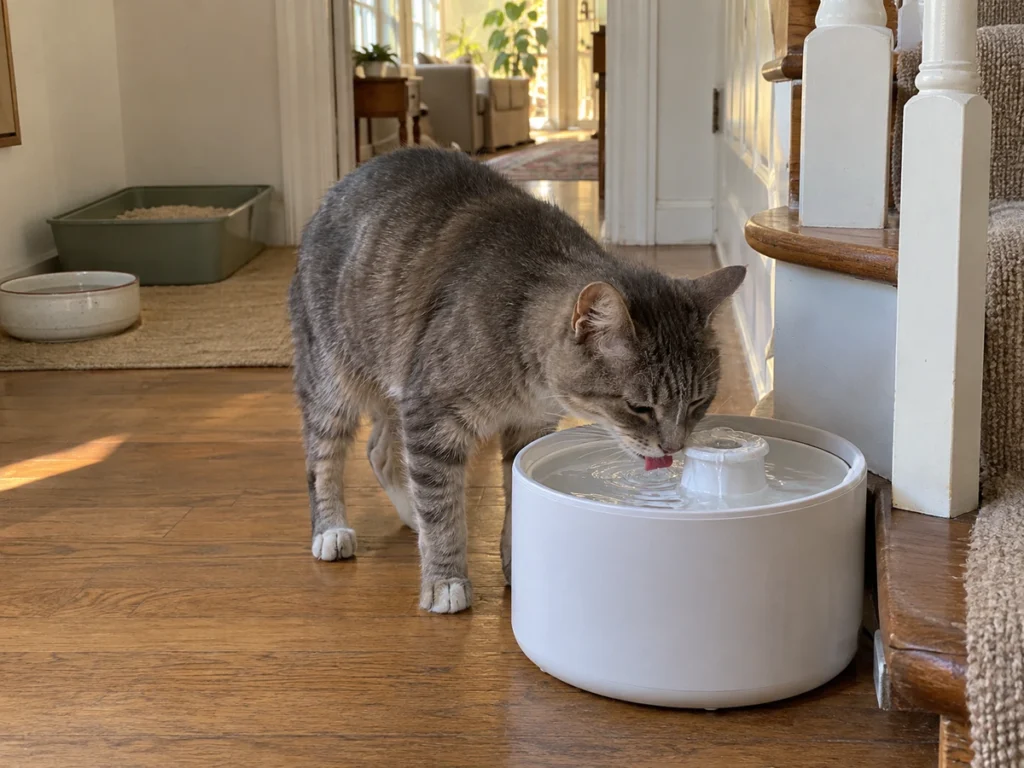
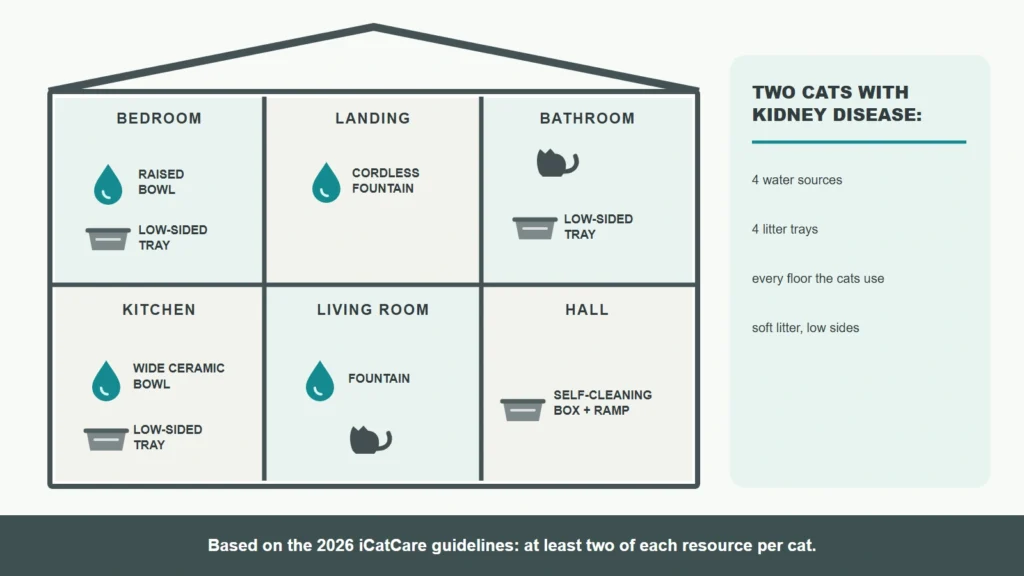
The environment section adds the numbers. “Resources should be distributed across all levels of the home and in sufficient number (at least two of each resource per cat).” Trays “should be low sided with a soft substrate and regularly cleaned”. The reason is practical. Cats with the disease drink and urinate more, and many older cats also have stiff joints, so a single tray two floors away becomes a problem.
This is not a niche condition. The panel cites studies putting its prevalence at 28 to 81 percent of cats over 12, depending on the population studied. It recommends screening from age 7 with weight checks, blood tests and a urine test, once a year up to age 10 and preferably twice a year after that. The most common early signs it lists are drinking more, urinating more and losing weight.
The count for a two-cat home
Two cats with kidney disease need at least four water sources and four litter trays under the guideline. One large fountain is still one source, however much it holds. So the question for a smart home is where each source sits.
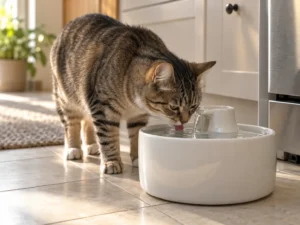
A cordless fountain helps with the “all levels of the home” part. The PETKIT EverSweet Max (Cordless) runs its pump from a battery, so it can go on a landing or in a bedroom with no socket nearby. Pair it with a wide ceramic bowl downstairs and a second fountain or bowl elsewhere, and a two-cat house reaches the count.
Whether a fountain on its own makes a cat drink more is less settled than the packaging suggests, and our look at what the fountain studies found shows how thin the trial evidence is. The guidelines recommend fountains as one of several ways to encourage drinking, alongside bowls and wet food. The number of sources and where they sit matter at least as much as which device you buy.
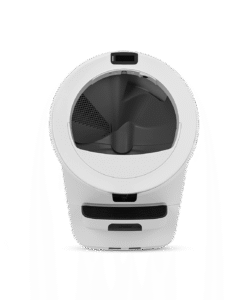
Trays follow the same arithmetic, and a self-cleaning box counts once. The Whisker Litter-Robot 4 is one tray, and it is not a low-sided one. Whisker sells a $65 ramp for cats “that need a little extra help”. For a stiff older cat, that ramp or a plain low tray nearby follows the guidance better than the robot alone.
Purina’s smart litter box study, in numbers
Purina’s paper, written with Ohio State University and published in the journal Animals in April, used load sensors under a litter box to classify each visit. Across 136 cats, those with kidney disease urinated about twice as often, 4.6 times a day against 2.3, spent longer doing it and covered for less time afterwards. A model then flags a cat when it looks like a kidney cat on 8 of 14 consecutive days.
The headline score is a weighted F1 of 89.9 percent in validation, a measure that blends accuracy across all the cats. Most of those cats were healthy, and the healthy ones were easy to call. The paper’s own table tells the part that matters to an owner:
| Group | Kidney cats caught | Healthy cats wrongly flagged |
|---|---|---|
| Training (13 kidney cats, 72 healthy) | 7 of 13 | 0 of 72 |
| Validation (7 kidney cats, 44 healthy) | 4 of 7 | 2 of 44 |
So the model missed about half the sick cats, including some at advanced stages. The kidney diagnoses in the validation group were reported by owners rather than confirmed by a vet, seven of the nine authors work for Purina, and neither the paper nor the release names the monitor. None of that makes the behavior pattern wrong. It does mean a quiet app is no evidence of healthy kidneys.
Reading your own litter box app
Your app will not run the study’s model. It counts visits and weighs the cat. On the Litter-Robot 4, the free app shows seven days of visits and individual weights. A Whisker+ membership adds longer history and trends for weight, visits and duration. Whisker does not advertise a separate count of urination visits, which is the signal the study leaned on.
The weight trend is the useful part, and the guidelines explain why. One study of more than 500 cats found a median loss of 8.9 percent of body weight in the year before diagnosis, with the loss already under way three years earlier. For a 5 kg cat that is about 445 g over twelve months, or under 40 g a month. You will not see it by eye, and a seven-day window will not show it either. A year of scale data will.
What to do this month
If your cat is 7 or older, book the yearly check with blood and urine tests, and make it twice a year once the cat passes 10. If the app shows visits climbing or weight sliding over several months, take those charts to the appointment. They give the vet a reason to test sooner.
For a cat that already has a diagnosis, do the count. Two water sources and two low trays per cat, on every floor the cat uses, is the target the panel set.