Clocks in most of the US fall back one hour at 2 a.m. on Sunday, November 1, 2026. A PETLIBRO feeder connected to its app moves with them, so a breakfast scheduled for 7:00 still drops at 7:00 on the wall clock. Your cat’s body clock doesn’t move, and by its reckoning that meal now comes an hour late. PETLIBRO says most pets settle within a few days, and you can soften the change by shifting the schedule in small steps during the last days of October.
What a connected feeder does at 2 a.m.
PETLIBRO’s help center says a feeder linked to the app and synced to your local time updates its own clock when daylight saving time begins or ends. Every schedule keeps running on the time the app shows. A connected model such as the PETLIBRO Granary 2 Smart Feeder needs nothing from you to stay on the wall clock.
The feeder takes its time zone from the network it joined during setup, and it keeps that zone afterward. A feeder set up in Chicago and moved to Denver would go on serving Chicago time, because a phone in a new zone doesn’t change it. Resetting the feeder and connecting it to the app again is the only way to give it a new zone.
At 2 a.m. on November 1 the clock goes back to 1 a.m., so the hour from 1:00 to 2:00 happens twice. PETLIBRO’s page doesn’t say whether a meal scheduled inside that hour drops once or twice. If your cat gets a snack at 1:30 a.m., move it to 2:30 for that one night.
An hour late by the cat’s clock
PETLIBRO’s own example keeps a 7:00 a.m. meal at 7:00 a.m. in the app before and after the change. That is right for the clock and an hour off for the cat. A cat that has eaten at 7:00 all summer gets hungry at the same point in its day. On November 1 that point arrives when the wall clock reads 6:00. The feeder then makes it wait until 7:00, and the evening meal slips by the same hour.
A cat on insulin needs more care, because its meals are tied to its injections. Ask your veterinarian before moving either one.
Moving meals in 15-minute steps
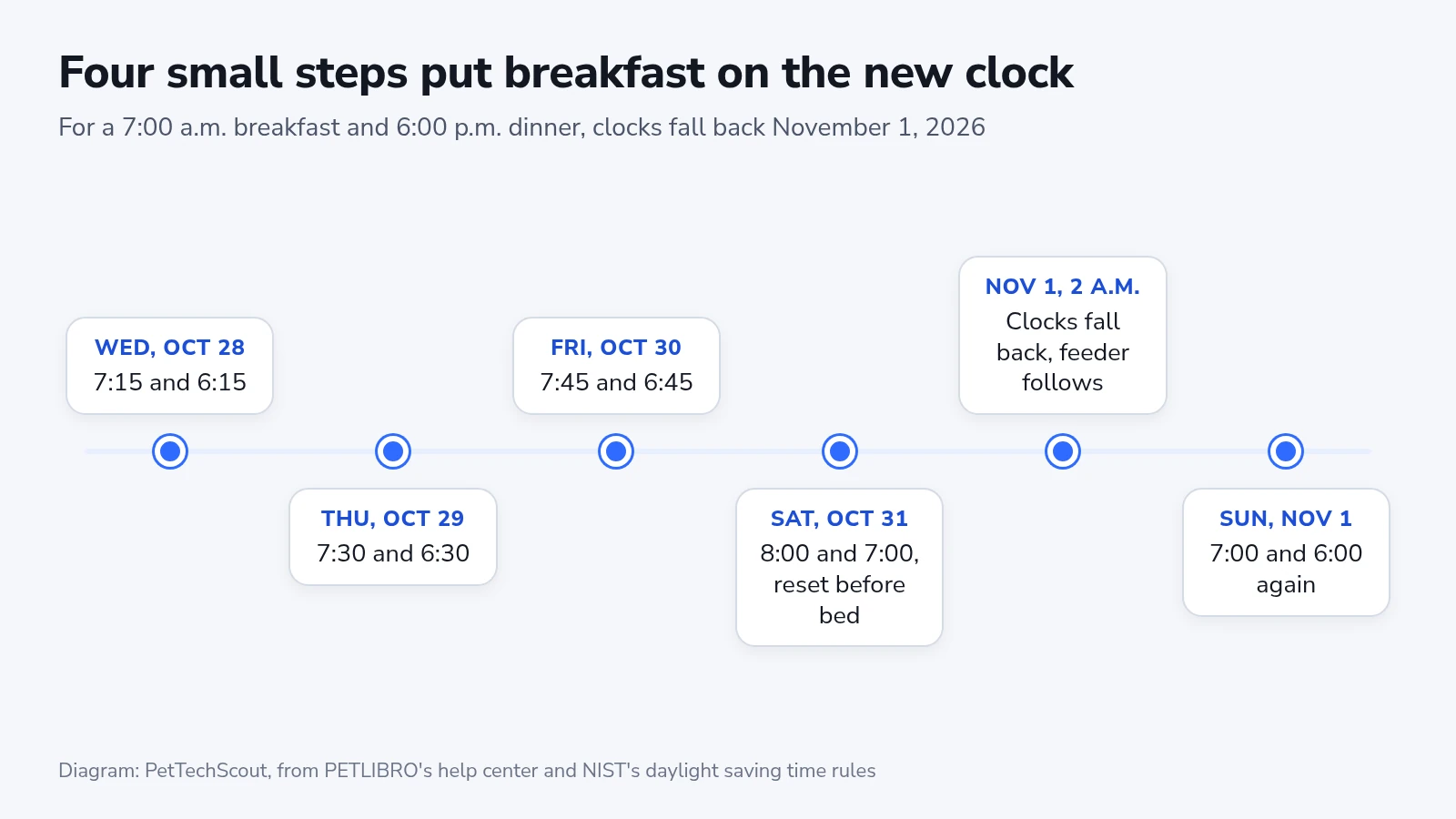
An app feeder makes it easy to split the hour into four steps. Set each day’s times the evening before:
- Wednesday, October 28: breakfast at 7:15 a.m., dinner at 6:15 p.m.
- Thursday, October 29: 7:30 and 6:30.
- Friday, October 30: 7:45 and 6:45.
- Saturday, October 31: 8:00 and 7:00.
- Before bed on October 31, set the meals back to 7:00 a.m. and 6:00 p.m.
The feeder follows the clock change at 2 a.m., so the 7:00 breakfast on November 1 lands at the moment your cat ate on October 31. The same goes for dinner. From then on the schedule reads the way it did all summer.
The steps assume a breakfast at 7:00 and a dinner at 6:00. With other times, add 15 minutes a day to each meal and set them back to the usual times on the last night.
Feeders without an app keep the old time
A feeder you program with buttons, such as PETLIBRO’s Easy Feed, keeps its own clock. PETLIBRO’s instructions for it describe setting that clock by hand and never mention daylight saving time. If the clock stays where it is, the feeder keeps serving at the old hour. That is the same moment by your cat’s body clock and an hour early by yours, so the 7:00 breakfast drops at 6:00 on the wall.
Leaving it that way through the winter is a real option, because the clocks spring forward on March 14, 2027 and line up with the feeder again. To set it now, hold the Setting button for three seconds and press OK. Use the Up and Down buttons to set the hour, press OK, set the minutes the same way, then press OK and Return.
If the time looks wrong on November 1
Check the feeder’s clock against your phone on Sunday morning. If it didn’t move, PETLIBRO says changing the phone’s time zone won’t help. A restart will: unplug the feeder, take out the backup batteries if it has them, and plug it back in so it syncs again. Do it before the next meal is due. Logged meals keep their old times.