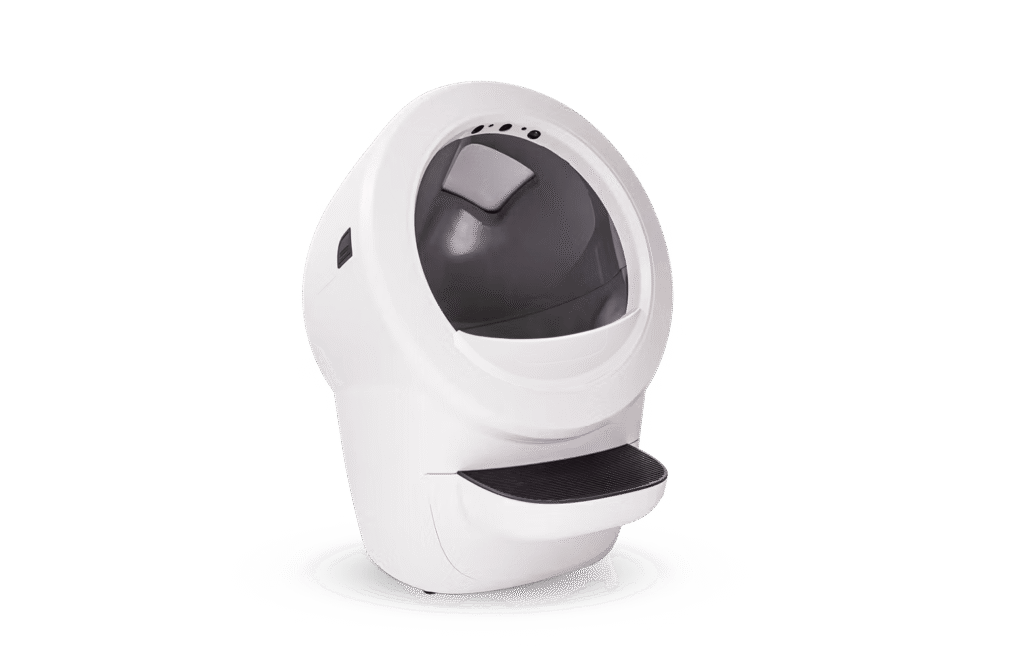
Litter-Robot 4 Review: The Mature Choice Now That the Litter-Robot 5 Has Arrived
Whisker launched the Litter-Robot 4 in 2022 and has kept it on sale after releasing the Litter-Robot 5. The older model did not get retired, it got repositioned as the cheaper of the two flagship boxes, with several years of firmware and app work behind it.
That history matters more than the spec sheet. A self-cleaning litter box is a motorized machine that a cat climbs inside every day, so the questions worth asking are whether the sifting mechanism jams, whether the sensors reliably notice a cat, and whether the company fixed the faults owners reported. Whisker's manual and its firmware release notes answer more of that than most makers publish.
Nobody on this team has run a Litter-Robot 4 at home, and no independent test is cited. Every factual claim below comes from Whisker's own manual, support pages and firmware release notes, and each is attributed where it appears.
Affiliate disclosure: the price links on this page may earn us a commission at no extra cost to you. Retailers cannot pay for placement or influence the score. How we stay independent
RecommendationConsider if you use clumping clay litter and your router can give it a separate 2.4 GHz networkEvidence: maker figures only · Specification score on the product page
A mature self-cleaning box with four years of documented firmware fixes, a rake-free sifting mechanism and a sealed waste drawer, held back by a radio that only speaks 2.4 GHz.
Strengths
The rotating sifting mechanism has no rake and no wires inside the globe
A sealed waste drawer with a carbon filter above it
Two detection methods, weight sensors plus laser curtain sensors, backed by documented anti-pinch and overload behavior
Weaknesses
Wi-Fi works on the older band only, and Whisker's own support article documents mesh routers steering the unit onto the newer band and breaking the connection
Only clumping litter, or crystals small enough to pass the screen, will work. Tofu, wood pellet and non-clumping litters are ruled out
Automatic mode ignores cats under 3 pounds, so kitten households run it manually until the kitten grows
Research-based: assessed from the manufacturer’s published specifications, documentation and the independent sources listed at the end. We have not tested this unit ourselves; any measurement quoted belongs to the cited source.
Method
Every physical measurement and operating rule in this review comes from the official Litter-Robot 4 instruction manual or from Whisker's support articles, and the account of fixes since launch comes from Whisker's firmware and app release history. No independent test of the cleaning cycle, odor control or value is cited, so those three sections carry no score. The design, safety and app sections are judged on documented behavior.
Evidence
Whisker publishes a 40 page multilingual manual with a full dimensions table, safety rules and a description of the cleaning cycle, plus support articles on network requirements and onboarding faults. It also keeps a dated firmware history for the Litter-Robot 4 that lists detection, scale, drawer-level and Wi-Fi fixes from 2023 to 2026.
Limitations
PetTechScout has not run a Litter-Robot 4, and no independent test of jamming, odor or the drawer-full alert is cited. Whisker does not publish a waste drawer volume, a cleaning cycle duration or a noise rating, so those values are absent from the specification record, with no estimate in their place. A check of published recall notices did not surface a Litter-Robot recall, which is not the same as confirming that none exists.
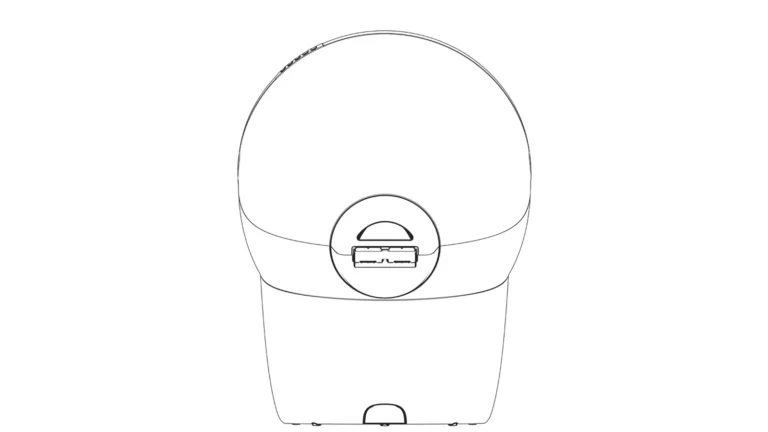
Rear view from the official Litter-Robot 4 manual. The globe sits above the base, and the power inlet is the only connection on the unit. Whisker Litter-Robot 4 instruction manual, official technical diagram
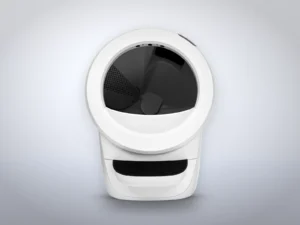
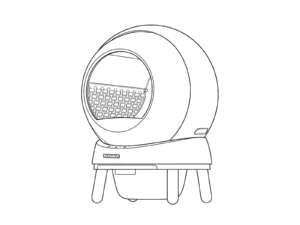
The Litter-Robot 4 is a globe on a pedestal. The upper sphere holds the litter and rotates to sift, the base holds the waste drawer, the electronics and the weight sensors. Nothing electrical sits inside the globe, which is the reason Whisker can state in the Litter-Robot 4 manual that there are no rakes or wires where the cat stands.
The published footprint is 22 by 27 inches, or 56 by 68.6 centimeters, and the unit stands 29.5 inches tall at 75 centimeters. Empty, it weighs 24 pounds, about 10.9 kilograms. Those numbers are worth measuring against a real corner before ordering, because the manual adds a rule that is easy to miss. The unit must not touch a wall on any side, since contact throws off the weight sensors that detect the cat. A box that fits the floor space may still not fit the clearance requirement.
Surface matters for the same reason. Whisker specifies a firm, level floor and sells a carpet tray for homes where that is not possible, stating that the weight readings are most accurate off carpet. The entryway is a circular opening measured at 15.75 by 15.75 inches, or 40 by 40 centimeters, and the step up from the floor to that opening is 30.5 centimeters. For an older cat or one with joint trouble, that climb is the single most important number in the table, and Whisker sells a ramp for it.
How the cleaning cycle works
Not rated · Evidence: maker figures only
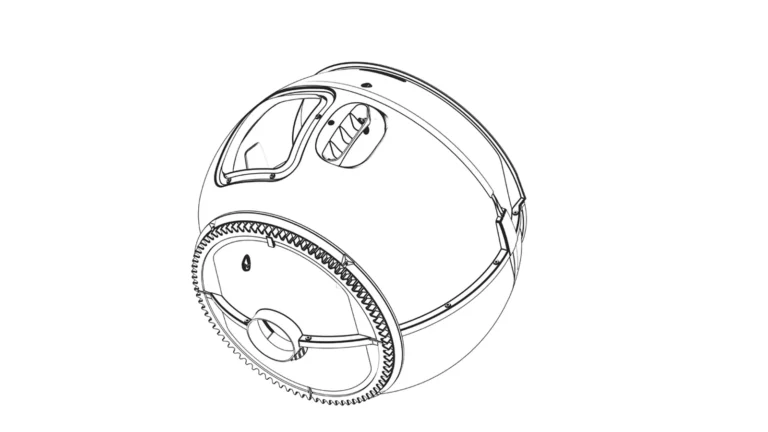
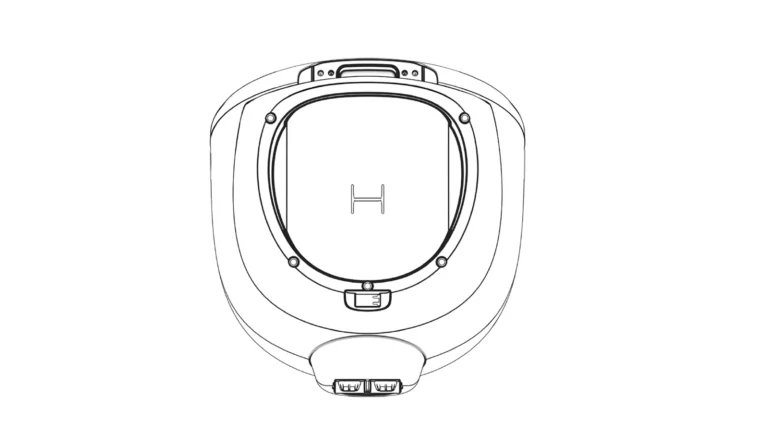
Globe seen from behind in the official manual. The toothed gear track around the rim drives the rotation, and waste leaves through the opening at the center. Whisker Litter-Robot 4 instruction manual, official technical diagram
The globe rotates counterclockwise after the cat leaves. A flexible liner inside falls away from the wall as the globe turns upside down, clumps drop through a screen into the waste port, and the globe then rotates back so the clean litter spills into place. Before it settles, it rotates past the home position once to level the bed. That sequence is set out step by step in the manual, and it explains why there is no rake to jam.
The delay before a cycle starts is adjustable from 3 to 30 minutes, with 7 minutes as the figure Whisker uses in its own guidance for waste to clump. If the cat re-enters during the countdown, the sensors restart it.
The constraint is litter type. Whisker specifies clumping litter, or beads and crystals small enough to fall through the screen, and rules out strictly absorbent, non-clumping, loose-clumping, newspaper and wood pellet products. Lightweight corn and wheat litters may not pass the screen properly. Anyone committed to a plant-based litter should treat that as disqualifying.
Odor control and the waste drawer
Not rated · Evidence: maker figures only
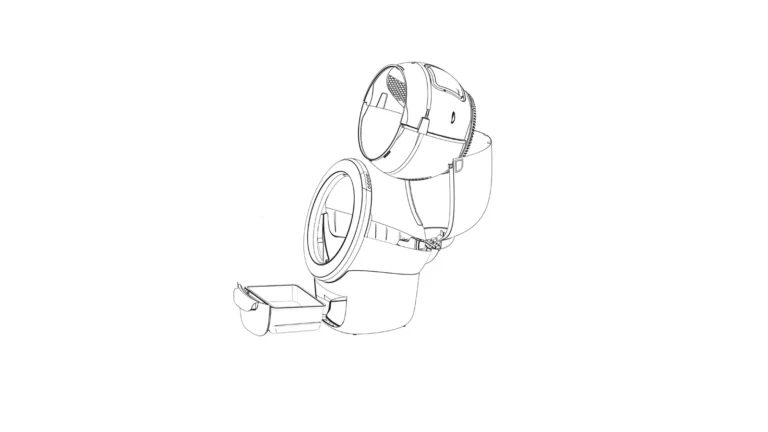
Exploded view from the official manual. The waste drawer slides out of the base, which is the part an owner handles weekly. Whisker Litter-Robot 4 instruction manual, official technical diagram
Waste falls into a drawer in the base that measures 5.5 by 13.5 by 9.25 inches, or 14 by 34.3 by 23.5 centimeters. Whisker does not publish a volume for it, so the manual instead gives a practical figure: the drawer takes a standard bin liner of 37 to 49 liters, and the company recommends changing it weekly for one cat and twice weekly for two.
Odor control rests on two things working together. The drawer seals, and a carbon filter sits above it, with optional scented packs available in place of the filter.
Whisker has reworked the drawer-full reading since launch. Its firmware notes for December 2023 and January 2024 describe a new algorithm meant to improve the accuracy of drawer-level measurements and let more waste collect before the alert, after a five-minute recalibration. If the app is your only prompt to empty the drawer, check that the update and the recalibration are done.
Safety, sensors and the cats it suits
Not rated · Evidence: maker figures only
Underside of the base in the official manual. The cat sensor and weight scale live here, which is why the manual insists on a firm, level floor and no contact with walls. Whisker Litter-Robot 4 instruction manual, official technical diagram
Whisker calls the detection system OmniSense, and it combines two different methods. Weight sensors in the base register a cat standing in the globe, and laser curtain sensors across the opening catch a cat that peeks in or steps in without putting enough weight down.
If a curtain sensor triggers during a cycle, the globe stops, and the manual states it waits 15 seconds after the cat leaves before resuming. Two anti-pinch safety features and an overload detection system cover the case where the globe jams or meets resistance. These are documented behaviors with described light-bar signals, and the manual is specific enough that an owner can tell a safety stop from a fault.
The cat side has two hard limits. Automatic mode needs a cat of at least 3 pounds, about 1.36 kilograms, because the weight scale will not register anything lighter. Whisker's own answer for kittens below that is to run the box unplugged and power it on manually after use, which works but defeats the point of an automatic box. At the other end Whisker rates it for cats up to 25 pounds, large breeds such as Maine Coons included, with a 15.75 inch entryway and a 15 to 17 inch interior height.
A 25 pound rating is not the same as comfortable for every large cat, and a Maine Coon owner should treat the 90 day home trial as the actual test.
The app, the Wi-Fi limit and what it costs to run
Not rated · Evidence: maker figures only
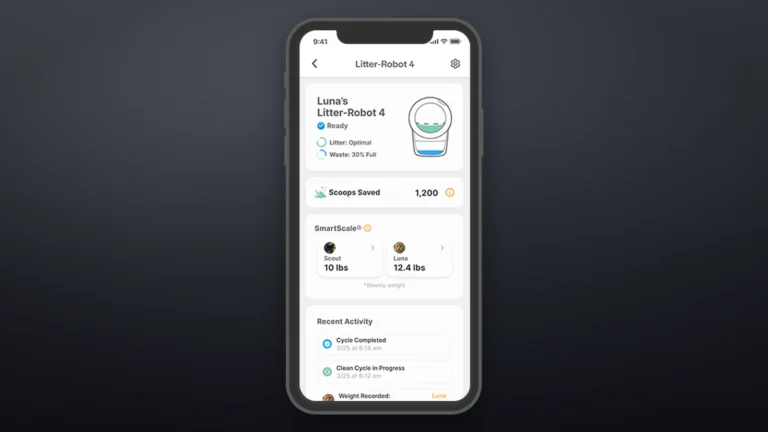
Whisker's own published app screenshot for the Litter-Robot 4. The SmartScale card is the part that turns the box into a passive weight record. Whisker app screenshot published by Whisker
The Whisker app shows litter level, waste drawer level, per-cat weight from the SmartScale and a running activity log of cycles and visits. It needs iOS 13 or Android 8 as a minimum, and several people in a household can use the same account. For a multi-cat home the weight history is the feature with real value, because a cat quietly losing weight is something an owner rarely notices and a scale under the litter box records every few days without anyone remembering to do it.
The connectivity limit is the part to check before buying. Whisker states that the Litter-Robot 4 requires a 2.4 GHz network and does not support 5 GHz. Its support article on onboarding failures goes further, warning that mesh routers combining both bands can steer the unit onto the faster band after a successful setup, at which point it disconnects and will not come back. The documented workaround is a dedicated guest network on the older band, and the same article asks owners to confirm that ports 443 and 8443 are open. That is more network administration than a litter box should need, and on a modern mesh system it is a realistic source of frustration.
A disconnected box still cleans. The cycle logic runs on the unit, and the panel buttons work regardless. What stops is the remote view, the alerts and the weight history, which is the same pattern across this category and one we have looked at in detail in what actually keeps working when a smart feeder or litter box goes offline.
Running costs are modest and mostly optional. Carbon filters and drawer liners are consumables, though the manual permits any 37 to 49 liter bin liner in place of branded ones. The warranty is WhiskerCare for one year, with a three year plan sold separately. The direction of travel is worth watching: Whisker's newest hardware ties some insight features to a paid Whisker plus membership, while the Litter-Robot 4's app functions do not require one today. Since the box sits on your home network and logs your cat's habits, it is also a reasonable candidate for our checklist for securing a smart pet device.
Value beside the Litter-Robot 5
Not rated · Evidence: maker figures only
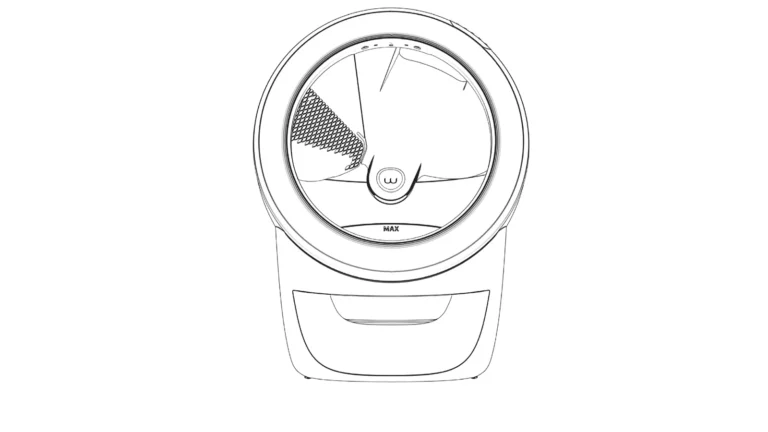
Front view from the official manual, with the screen inside the globe and the MAX fill line marked below the opening. Whisker Litter-Robot 4 instruction manual, official technical diagram
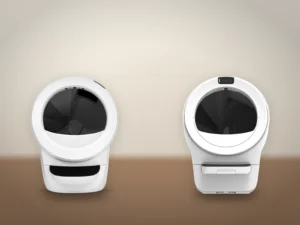
Whisker now sells four Litter-Robots: the 5 Pro, the 5, the 4 and the smaller EVO. The Litter-Robot 5 is built on the same footprint as the 4 and adds WasteID, which Whisker says distinguishes solid from liquid waste, an updated scale, and support for up to five cats between 3 and 30 pounds. The 4 is rated for up to four cats. Whisker dropped the price of the 4 when the 5 launched, and the gap between them is the whole question.
Whisker's release history for the Litter-Robot 4 lists firmware that adjusted the scale thresholds for better cat detection, cut "Excess Weight Detected" faults, improved Wi-Fi connectivity and reworked the drawer-full reading, from late 2023 into 2026. A buyer in October 2026 gets the version that came out of that work, while the 5 is at the start of its own cycle. The 5 Pro is also the first model designed around Whisker's paid membership, which is a different ownership proposition.
Outside Whisker's range, the PetSafe ScoopFree SmartSpin is a cheaper rotating design, covered in our SmartSpin review.
Where to buy
In-stock offers for this exact model, sorted by item price in USD. Shipping is not included unless a retailer supplies it. Not every retailer is listed. Prices last checked 13 hours ago.
Prices and availability come from retailer feeds and change without notice; the retailer’s page is authoritative. We may earn a commission if you buy through these links.
✓
Final verdict
Litter-Robot 4
RecommendationConsider if you use clumping clay litter and your router can give it a separate 2.4 GHz network
This review gives no score out of 10, because no section rests on a measurement by an independent body. The recommendation and the written verdict stand on their own.
Pros
The rotating sifting mechanism has no rake and no wires inside the globe
A sealed waste drawer with a carbon filter above it
Two detection methods, weight sensors plus laser curtain sensors, backed by documented anti-pinch and overload behavior
Per-cat weight logging that builds a passive health record in a multi-cat home
Four years of dated firmware and app updates and a published manual
Cons
Wi-Fi works on the older band only, and Whisker's own support article documents mesh routers steering the unit onto the newer band and breaking the connection
Only clumping litter, or crystals small enough to pass the screen, will work. Tofu, wood pellet and non-clumping litters are ruled out
Automatic mode ignores cats under 3 pounds, so kitten households run it manually until the kitten grows
Litter-Robot 5 gets an updated scale and a higher rated cat count on the same footprint
Conclusion
The Litter-Robot 4 is the version of this product that has already been debugged in public. The mechanism is simple, the safety systems are documented in detail, and the fixes since launch are listed in Whisker's own release notes. For a machine that a cat has to trust every day, that history is worth more than a new feature list.
Two things should decide it. Check your litter, because only clumping clay or small crystals sift properly. Then check your router, because a box that only speaks 2.4 GHz on a band-steering mesh network is a support ticket waiting to happen. If both check out, the gap to the Litter-Robot 5 is a question of budget.
Our take
Reading Whisker's documentation next to four years of its release notes leaves a clear impression: this is a company that keeps fixing things, and that publishes enough detail for an owner to tell a safety stop from a fault. That is rarer in pet tech than it should be, and it is most of the reason the Litter-Robot 4 still holds a recommendation next to its own replacement. The part that gives pause is not the hardware. It is the direction shown by the newest model, where insight features attach to a paid membership. The 4 predates that, and buyers who dislike subscriptions may find the older box is the one that stays useful on their terms.
Best for
Multi-cat homes that would use per-cat weight history as an early health signal
Average-sized cats on clumping clay litter
Buyers who value a documented repair path and four years of firmware fixes over the newest hardware
Homes with a stable network on the older Wi-Fi band, or a router that can split one off as a guest network
Consider an alternative if
You use tofu, wood pellet or non-clumping litter and won't give it up
Your only network is a mesh system that steers devices between bands and cannot be split
You have a kitten under 3 pounds and want automatic cleaning from day one
You want the Litter-Robot 5's newer sensors and can pay more
Does the Litter-Robot 4 work without an internet connection?
The cleaning cycle runs on the unit itself, so it keeps sifting and the panel buttons keep working when the connection drops. What stops is remote control, alerts, the litter and waste readouts and the weight history, all of which need the app.
Will it connect to a 5 GHz network?
No. Whisker states that the Litter-Robot 4 requires a 2.4 GHz signal and does not support the faster band. On a mesh router that combines both bands, Whisker's support article recommends a dedicated guest network on that band, because band steering can disconnect the unit after a successful setup.
Can kittens use it?
Kittens can use the globe, but the scale will not register a cat under 3 pounds, so automatic mode will not trigger. Whisker's own guidance is to leave the unit powered off and run a cycle manually after use until the kitten is heavy enough.
What litter does it need?
Clumping litter, or beads and crystals small enough to fall through the screen. Whisker rules out strictly absorbent, non-clumping, loose-clumping, newspaper and wood pellet litters, and notes that lightweight corn and wheat products may not pass the screen properly.
How often does the waste drawer need emptying?
Whisker recommends changing the drawer liner weekly for one cat and twice weekly for two. The drawer takes a standard 37 to 49 liter bin liner, so branded liners are optional.
Is it still worth buying now that the Litter-Robot 5 exists?
For most buyers, yes. The 4 has four years of documented firmware fixes behind it and costs less, while the 5 adds an updated scale, WasteID and a higher cat count on the same footprint, so buyers without a budget constraint have a reason to spend more.
Andreea reads PetTechScout’s articles, guides and reviews before they are published. When she has also checked a piece against its sources, the note at the end of it says so, with her name and the date.
This is a research-based assessment: the reviewer compiled it from published specifications, documentation and independent measurements rather than from testing the unit.
We keep cookies to a minimum. Without your consent, this site sets only the ones it needs to work: remembering your answer here and keeping the site secure. If you allow analytics cookies, Google Analytics counts visits and shows us which pages people read. If you allow functional cookies, two optional features can use them: Google sign-in for posting a review, and remembering embedded videos you choose to always show. The site is also set up for Google AdSense ads; the cookie policy explains how Google uses cookies once ads run. Cookie policy
Customise consent preferences
Each category below lists the exact cookies behind it, what they do and how long they last. Strictly necessary cookies cannot be switched off because the site would stop working without them. Anything else is yours to decline.
NecessaryAlways active
Strictly necessary cookies keep the site working and secure: they remember your choice here, help the security layer stop attacks and keep site accounts signed in to the admin area. The site cannot run without them.
Show the cookies in this category (10)
cmp_consent
PetTechScout · 1 year
Remembers your consent choice for each cookie category, so the banner does not ask again on every page.
cmp_visitor
PetTechScout · Session (until you close the browser)
Marks your browser as a real visitor, so a comparison page is built when someone actually opens one rather than when a crawler passes through. It holds the value 1 and nothing else: no identifier, no history.
__cf_bm
Cloudflare · 30 minutes
Tells automated traffic from real visitors at the security layer that sits in front of this site. It holds a bot score, not an identity, and is not used for advertising.
cf_clearance
Cloudflare · Set by Cloudflare (typically 30 minutes)
Records that your browser passed a security check, so you are not challenged again on every page. Set only if a check was shown to you.
wp-settings-(id), wp-settings-time-(id)
WordPress · 1 year
Remembers layout preferences inside the WordPress admin screens. Set only for accounts that sign in to run the site, never for ordinary visitors.
WordPress · Session, or 14 days if “Remember me” is ticked
Keeps a site account signed in to the WordPress admin, and checks that the browser accepts cookies at login. Set only for accounts that sign in to run the site, never for ordinary visitors.
wfwaf-authcookie-(hash)
Wordfence (Defiant, Inc.) · 12 hours
Lets the Wordfence firewall check a signed-in user’s access level before WordPress loads, so administrators are not blocked by firewall rules. Set only when you log in to the site.
wf_loginalerted_(hash)
Wordfence (Defiant, Inc.) · Persistent
Records that the administrator has already been alerted about a sign-in from this device. Only used if login alerts are enabled, and set only when you log in to the site.
wfCBLBypass
Wordfence (Defiant, Inc.) · Only if enabled
Allows a visitor who knows a hidden bypass address to pass country blocking. It is only used if country blocking is enabled, and we do not currently use it.
wfls-remembered-(hash)
Wordfence (Defiant, Inc.) · Up to 30 days
Remembers a trusted browser for two-factor login when a signed-in user chooses “remember this device”. Set only for site accounts that use two-factor authentication.
Functional
Functional cookies are set only when you use a feature that needs them: signing in with Google to post a review, or ticking “Always display content from …” on an embedded video or post. Decline and the rest of the site works exactly as before: Google sign-in stays off, and embedded videos still load one at a time when you click them.
Show the cookies in this category (2)
g_state (and Google’s own sign-in cookies)
Google · Set by Google
Set only if you use the Google sign-in button to post a review. It remembers the state of that prompt so it is not shown again. Governed by Google’s own policy.
embed-privacy
PetTechScout · 1 year
Remembers the providers whose embedded content you chose to always display (for example YouTube), so their videos and posts load without a click. Set only when you tick “Always display content from …”, a box that appears only once functional cookies are allowed.
Analytics
Analytics cookies let Google Analytics count visits and show us which pages people read and how they found them, so we know what to improve. Google Analytics loads only after you switch this on. Google signals and ad personalization are turned off, and Google Analytics does not log or store IP addresses. Decline and the site works exactly the same.
Show the cookies in this category (2)
_ga
Google (Google Analytics) · 13 months
Gives your browser a random ID so Google Analytics can tell new visitors from returning ones. It holds no name, email address or account. Set only after you allow analytics cookies.
_ga_EX5QH7JLFF
Google (Google Analytics) · 13 months
Keeps track of the current visit for this site’s Google Analytics property, such as when it started and how many pages it covered. Set only after you allow analytics cookies.
Advertising (Google AdSense)
This site is set up for Google AdSense. No ads are shown until Google approves the site. In the EEA, the UK and Switzerland, Google asks for your consent in its own message before it uses advertising cookies, and that message also decides Google Analytics there. Elsewhere, you can turn off personalized ads in Google’s ad settings.
Show the cookies in this category (2)
FCCDCF, FCNEC
Google (consent message) · Up to 13 months
Stores the choices you make in Google’s consent message, which visitors in the EEA, the UK and Switzerland see, so the message does not appear on every page.
__gads, __gpi, __eoi
Google (AdSense) · Up to 13 months
Used by Google AdSense to show ads, limit how often you see the same ad and detect fraud. Set only on pages that show an ad; no ads are shown until Google approves the site.
Set by other sites
These are set by another company, not by this site: a retailer, after you click through to its website, or a video or social-media provider, after you click to load its content here. That company’s own policy governs them, not this banner.
Show the cookies in this category (2)
Embedded video and social-media cookies
YouTube, Vimeo, TikTok, Instagram, Spotify, X, Reddit · Set by the provider
Articles can embed a video or post. Nothing loads from the provider until you click its placeholder; when you do, the provider may set or read its own cookies under its own policy. YouTube videos load in YouTube’s privacy-enhanced mode (youtube-nocookie.com).
Retailer / affiliate cookies
Amazon & affiliate networks · Set by the retailer
Set on the retailer’s own website after you click a “View deal” or “Check price” link, to attribute a purchase. We do not set or read these.