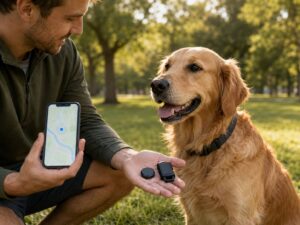

On September 4, 2026, at IFA 2026 in Berlin, petpogo announced a set of AI pet products built around a PetPhone wearable, a PetCam camera and a companion app. The pitch is direct. The system reads movement patterns and vocal cues, then expresses them as recognizable emotional states in human language, using a vocalization database the company describes as spanning millions of recorded animal sounds. No accuracy figure appears in the announcement, and no launch date or price appears either. So AI dog bark translation is worth examining against the published research.
What researchers have built
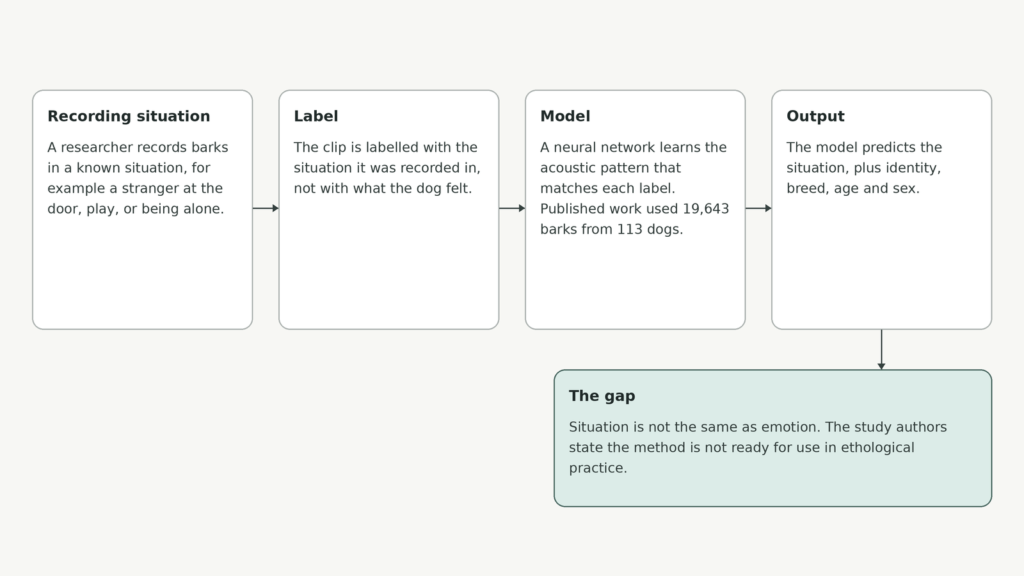
The strongest recent work on this problem was published in Behavioural Processes in 2024 by Gómez-Armenta and colleagues. The team worked with 19,643 barks recorded from 113 dogs of different breeds, ages and sexes, then trained deep neural networks to classify each recording.
The models predicted several things at once. They identified the individual dog, the breed, the age, the sex and the context in which the bark was recorded. The authors report performance that surpassed earlier results on the same task, which is a real advance.
They also wrote something that rarely reaches a product page. Their own conclusion states that the application of the method is not ready for use in ethological practice. The people closest to the data set the ceiling lower than any vendor does.
Context is not the same thing as emotion
This is the distinction that decides whether a translation claim holds up. Research models are trained on the situation a recording came from. A clip gets labeled as a stranger at the door, or play, or isolation, because a researcher knew the setup when the microphone was running.
A model that learns those labels predicts the situation, not the feeling. Those two things overlap, and they are not identical. A dog barking at a delivery driver may be alarmed, excited, bored or rehearsing a habit, and every one of those barks carries the same label in the training data.
So when an app reports that your dog is anxious, the honest reading is narrower. The audio resembles clips recorded in situations a human called anxious. That can still be useful. It is not a translation.
Why a big dataset does not settle the question
Millions of recorded sounds is an impressive number, and it answers a smaller question than it appears to. Three other numbers matter more.
The first is how many individual animals those recordings came from. Thousands of clips from a few hundred dogs teach a model about those dogs, and the published study was explicit about its 113 animals for exactly that reason. The second is how the clips were labeled, because a label produced by one person watching a video carries that person’s interpretation into the model. The third is how the system performs on dogs it has never heard, in homes it has never been in, over a microphone it was not tuned for.
None of those figures appear in the IFA announcement, so how the system behaves on a dog that was not part of its training data is unknown.
Questions worth asking before you buy
Ask for an accuracy figure and the conditions behind it. A number without a test set is not a claim. Ask whether the evaluation used dogs the model had never heard, because performance on familiar animals runs far ahead of performance on new ones.
Background noise is the next question, since a kitchen with a television running is nothing like a recording session. Then ask whether the results were reviewed by anyone outside the company. Published research invites that scrutiny. Product pages usually do not.
The features on these devices that can be checked
Some of what petpogo announced is measurable in a way that emotion decoding is not. Boundary alerting is the clearest example. The company says the PetPhone notifies owners as a pet nears a boundary and calls them once it crosses.
That behavior has a right answer, and you can test it. Walk the boundary, count the seconds until the alert arrives, and repeat it under trees and near buildings. Trackers already on sale work the same way, so a device like the Life360 Pet GPS can be judged on how quickly its virtual fence fires and how much battery that costs. The emotion feature escapes that kind of test for now, and that is a reason to trust it less.
The privacy cost of an always-listening pet device
A microphone that classifies barks has to listen continuously, and it sits in your living room. Find out whether audio is processed on the device or uploaded, how long recordings are retained, and whether they are used to train future models.
Check what happens to the features when the internet drops, and check whether the emotional analysis sits behind a subscription. A camera that keeps recording locally during an outage is a different product from one that goes blank.
What to do with the output
Treat an emotion label as a prompt to look. If an app flags distress while you are out, the useful next step is watching the footage around that timestamp and noting what happened before the barking started. Patterns across days carry far more information than any single label.
Behavior that changes suddenly deserves a veterinary appointment. Loss of appetite, new night-time restlessness, altered toileting and unusual vocalizing can all have medical causes, and no app or wearable diagnoses them.
Where this leaves the technology
Bark classification is a genuine research field with measurable progress and honest published limits. Products for pet owners built on it are running ahead of that evidence, and the gap is not hidden. It sits in the conclusion of the leading paper. Buy these devices for the parts you can verify, such as location, boundary alerts, video and two-way audio. Treat the emotional read as an experiment you are helping to run.