The US Food and Drug Administration published a recall notice on September 8, 2026 for two Fi dog supplements that may carry Salmonella. Fi announced the recall itself on September 3, 2026. If you own a Fi smart collar, the first thing to know is that the collar is not part of this. The recall names two specific lot numbers of two powdered supplements, and nothing else. Still, the details matter, because Salmonella in a pet product is a risk to the people in the house as well as the dog. This article sets out exactly what was recalled, how to check a tub you already own, and what to watch for afterwards.
What was recalled, and on what date
The company announcement is dated September 3, 2026. The FDA posted it on September 8, 2026, listing the company as Vet Plus, Inc. and the brand as Fi, of New York.
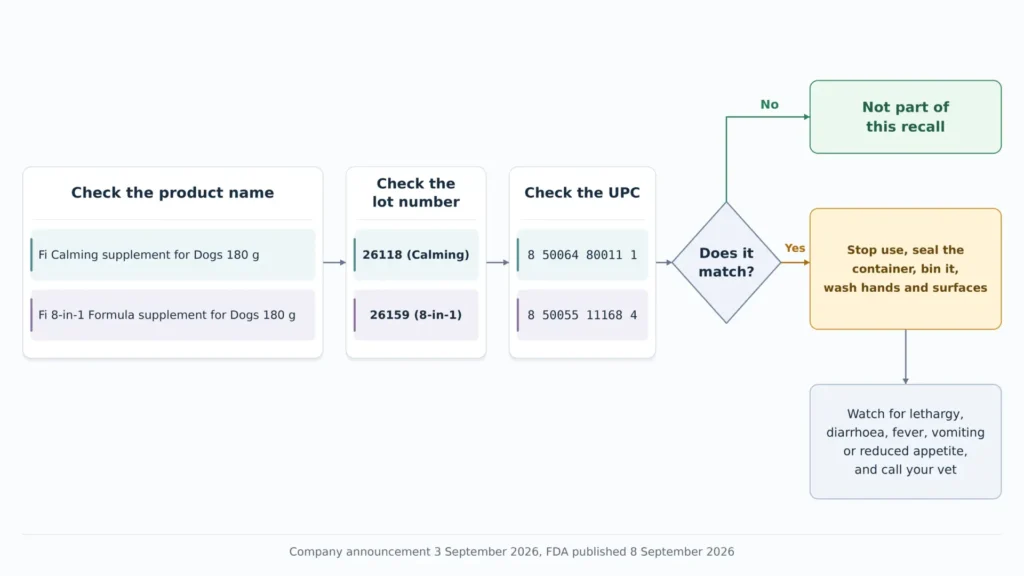
Two products are covered, and only one lot of each:
- Fi Calming supplement for Dogs, 180 g, lot number 26118, UPC 8 50064 80011 1
- Fi 8-in-1 Formula supplement for Dogs, 180 g, lot number 26159, UPC 8 50055 11168 4
Both were sold directly to consumers and through Amazon and Chewy.com. The stated reason is potential Salmonella contamination traced to an ingredient supplied to Fi’s manufacturer, and that manufacturer has suspended production while it investigates. The announcement does not report any illnesses.
Lots and products outside the recall
Read the lot number before you do anything else. A tub of the same product from a different lot is not part of this recall. Neither is any other Fi supplement, and neither is any Fi hardware.
That distinction gets lost quickly once a recall reaches social media. Fi is known first as a GPS collar brand, so headlines that say “Fi recall” push collar owners toward the wrong conclusion. The trackers, the charging bases and the app are untouched by this notice.
Why a dog supplement becomes a human health issue
Salmonella spreads by contact, not only by eating. The FDA notice is explicit that people can be infected by handling a contaminated product or by handling animal waste after a dog has eaten it. Hand washing after contact with the product, with surfaces it touched, or with waste is the single most effective step.
In people, the notice lists nausea, vomiting, diarrhea or bloody diarrhea, abdominal cramping and fever. It also notes rarer outcomes including arterial infections, endocarditis, arthritis, muscle pain, eye irritation and urinary tract symptoms. Anyone who develops those symptoms after contact with the product should contact a healthcare provider.
Signs to watch for in your dog
The notice describes infected pets as lethargic, with diarrhea or bloody diarrhea, fever and vomiting. Some dogs show only reduced appetite, fever and abdominal pain, which is a much quieter picture and easier to miss.
There is a further point that owners of multi-pet households should take seriously. A dog can be infected, appear healthy, and still shed the bacteria, so it can pass the infection to other animals or to people. If your dog ate a recalled lot and shows any of those signs, call your vet.
Your smart collar will not catch this
Activity trackers have improved a great deal, and some now log sleep, movement patterns and scratching, then flag changes in those trends. That is useful for spotting a slow decline. It is not a diagnostic tool, and no manufacturer claims otherwise.
The Tractive DOG 6 is a fair example of where the category sits. It logs activity, sleep and scratching, and raises alerts when the pattern shifts, while the company is careful to say it is not a medical device. So a tracker might show that your dog moved less yesterday. It will not tell you why, and it will not detect a bacterial infection. Treat any alert as a prompt to look at your dog.
What to do if you have an affected tub
The FDA notice gives clear instructions. Stop using the product, make sure the container is sealed tightly, and put it in the bin. Do not empty it into a compost heap or a garden, and do not pass it to another owner.
Wash your hands afterwards, and clean any surface the powder touched, including the scoop, the bowl and the shelf it stood on. Fi lists a consumer phone line, 1-888-434-3647, open seven days a week from 10am to 8pm Eastern Time, along with a support email address in the notice. Owners can also report an adverse event to the FDA’s Center for Veterinary Medicine using Form FDA 1932a.
Why ingredient recalls reach further than one brand
The cause here is a supplied ingredient. Contract manufacturers usually supply several brands from the same facility, so an ingredient problem can surface again under a different label weeks later.
That is why the manufacturer suspending production matters more than the size of this recall. It suggests the investigation is looking upstream. Keep an eye on further notices if your dog takes supplements from any brand, because the batch codes are what tie them together.
The wider lesson for connected pet brands
Pet-tech companies increasingly sell consumables alongside hardware, and the two carry very different risks. A firmware bug annoys you. A contaminated powder can make your household ill.
So treat the two product lines separately when you assess a brand. Check lot numbers on anything your dog eats, keep the packaging until the tub is finished, and do not assume that a company’s record with electronics tells you anything about its food supply chain.