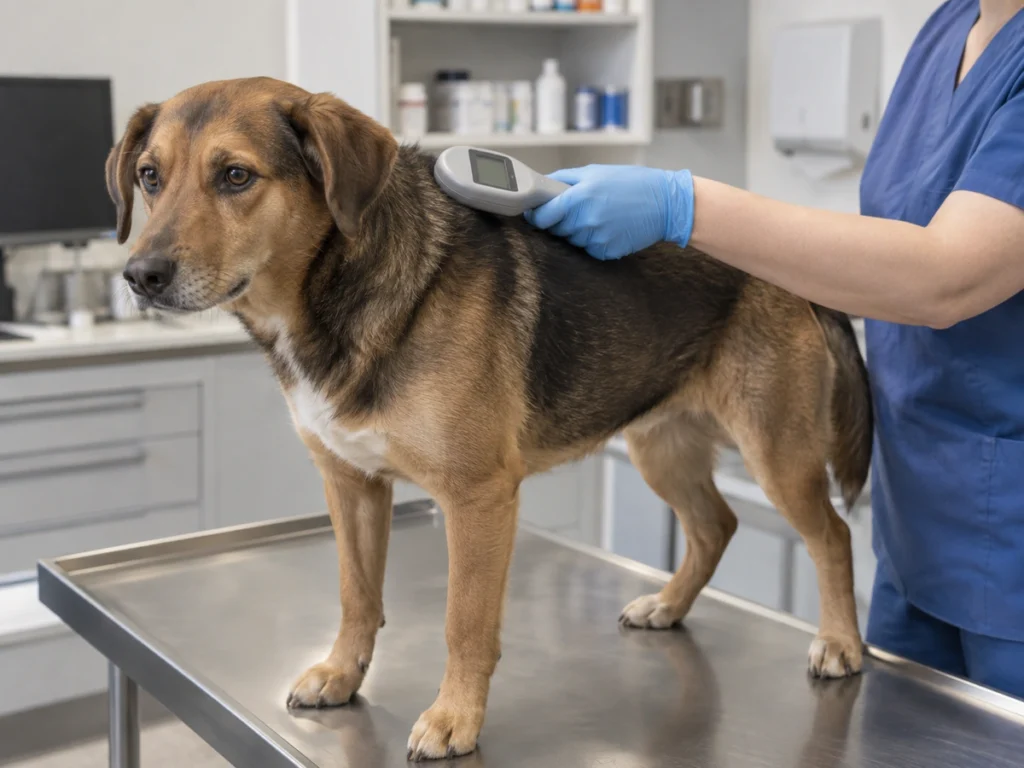
A pet microchip does not track anything. The American Veterinary Medical Association states it plainly: a microchip is not a GPS device and cannot follow your animal. Yet the microchip remains the single most effective identification tool a lost pet can carry, and the largest study of its kind shows exactly why it works and exactly how it fails.
What a microchip really is
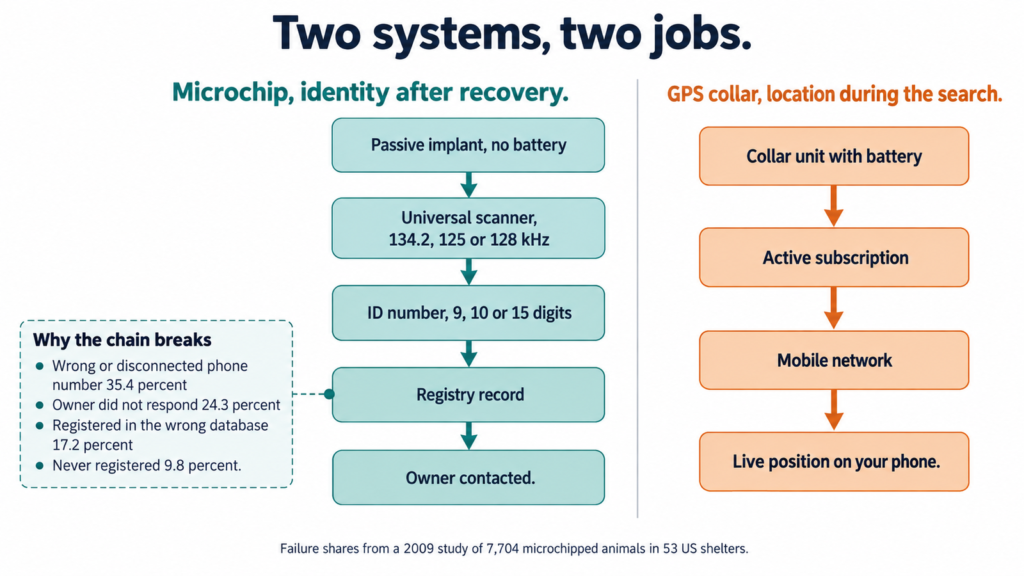
The implant is a small electronic device inside a glass cylinder, roughly the size of a large grain of rice. It carries no battery and no internal power source of any kind. The chip stays inert until a compatible scanner passes over it. Radio waves from that scanner power the chip briefly, and the chip answers with one number.
That number is all it holds. Most chips return nine, ten or fifteen digits, and some also report the animal’s body temperature. No name, address or phone number lives on the chip. The identification number points to a registry record, and the registry holds your details.
A veterinarian implants the chip under the skin, usually between the shoulder blades, using a preloaded syringe. No surgery or anaesthesia is needed, though the needle runs slightly larger than a vaccination needle. Because there is no battery, the implant normally lasts the animal’s lifetime.
What the recovery evidence shows
The reference study here comes from Linda Lord and colleagues at Ohio State University, published in the Journal of the American Veterinary Medical Association in 2009. The researchers followed 7,704 microchipped animals through 53 shelters across 23 states, with data collected between August 2007 and March 2008.
Shelters located owners for 72.7 percent of those microchipped animals, and 73.9 percent of the owners who were reached wanted their pet back. Compared with stray animals carrying no chip, microchipped dogs went home about 2.5 times as often and microchipped cats about 20 times as often. The gap for cats is the striking result, because cats without identification are rarely reunited at all.
One more figure from that work sets the context. Only 1.8 percent of all stray dogs and cats arriving at the participating shelters had a microchip in the first place.
Why chips fail, and what the failure list teaches
The same study recorded why shelters could not reach an owner, and the breakdown is more useful than the headline percentages.
| Reason the owner was not reached | Share of failures |
|---|---|
| Incorrect or disconnected phone number | 35.4% |
| Owner did not respond to calls or letters | 24.3% |
| Microchip registered in the wrong database | 17.2% |
| Microchip never registered | 9.8% |
Read the top line again. More than a third of failed reunions came down to a phone number that no longer worked. Not a chip failure, not a scanner problem, not a shelter mistake. A stale contact record.
So the practical instruction is short. Register the chip, then update the registry every time you change your phone number or move house. The AVMA marks August 15 each year as Check the Chip Day for exactly this reason.
Frequencies, scanners and the compatibility trap
Pet microchips in the United States run at one of three frequencies. The ISO standard frequency is 134.2 kHz, which pairs with fifteen digit identification numbers and is the frequency used in most countries. Older non-ISO chips run at 125 kHz or, less often, 128 kHz.
Universal scanners read all three, and veterinary clinics, shelters and animal control agencies now use them widely. Older single-frequency scanners do not. No federal or state rule forces a single standard in the United States, so both chip families remain in circulation.
Two chips in one animal cause no problem, because they do not interfere with each other. A universal scanner will usually find both if the operator resets it after the first read. Anyone whose pet carries two chips needs to keep both registry records current, since either one might be the chip that gets detected.
The travel rule that catches people out
International movement is where frequency stops being an academic question. Many countries require a fifteen digit ISO microchip before a dog or cat may enter. A dog returning to the United States also needs a microchip, though that one does not have to be a fifteen digit chip provided a universal scanner can read it.
The asymmetry matters. A pet with a 125 kHz chip may be perfectly traceable at home and unreadable at a European shelter that only owns ISO scanners. Adding a second, ISO-compliant chip is permitted, and both chips will keep working.
Where a GPS tracker fits
A tracker answers the question a microchip cannot: where is the animal right now. Collar-mounted cellular trackers report position continuously over a mobile network, which is a different job from proving identity after someone has already picked the animal up.
The trade is cost and dependence. A cellular tracker needs an active subscription to do anything at all, and the hardware is inert without it. Our specification page for the Tractive DOG 6 sets out that arrangement in detail, including the two very different battery figures the manufacturer quotes depending on whether power saving zones are switched on. A collar can also come off, run flat or be removed, which is precisely the situation a microchip covers.
So the two tools are complements. The tracker shortens the search. The chip proves ownership once the search ends, and it keeps working years later with no battery, no account and no monthly bill.
The collar detail almost nobody mentions
Here is a practical point that sits exactly where pet technology and microchipping meet. The AVMA lists the conditions that interfere with scanning, and one of them is a metal collar or a collar carrying a lot of metal. Long matted hair near the implant site and heavy fat deposits in that area cause similar trouble, as does an animal that will not hold still.
Modern GPS collars are bulky, and many carry metal clasps, metal housings and charging contacts. None of that stops a careful full-body scan with a universal scanner. It does argue for removing the collar before a scan rather than scanning around it, and it is worth saying out loud to whoever handles your animal.
A short checklist
Confirm the microchip number and which registry holds it. Use the American Animal Hospital Association lookup tool if you do not know, remembering that the tool identifies the registry rather than displaying contact details. Register the chip in your own name if you adopted the animal. Check the phone number on file today, because that field causes more failed reunions than every technical fault combined. Ask your veterinarian to scan the chip at each annual visit, since migration away from the implant site is the most commonly reported complication. And keep a collar tag on the animal, because a neighbor who finds your dog can read a tag without owning a scanner.