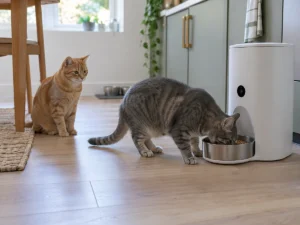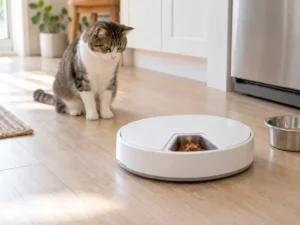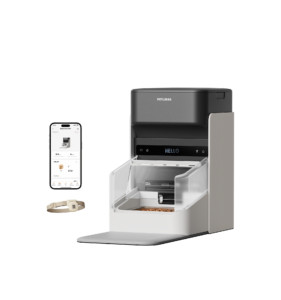
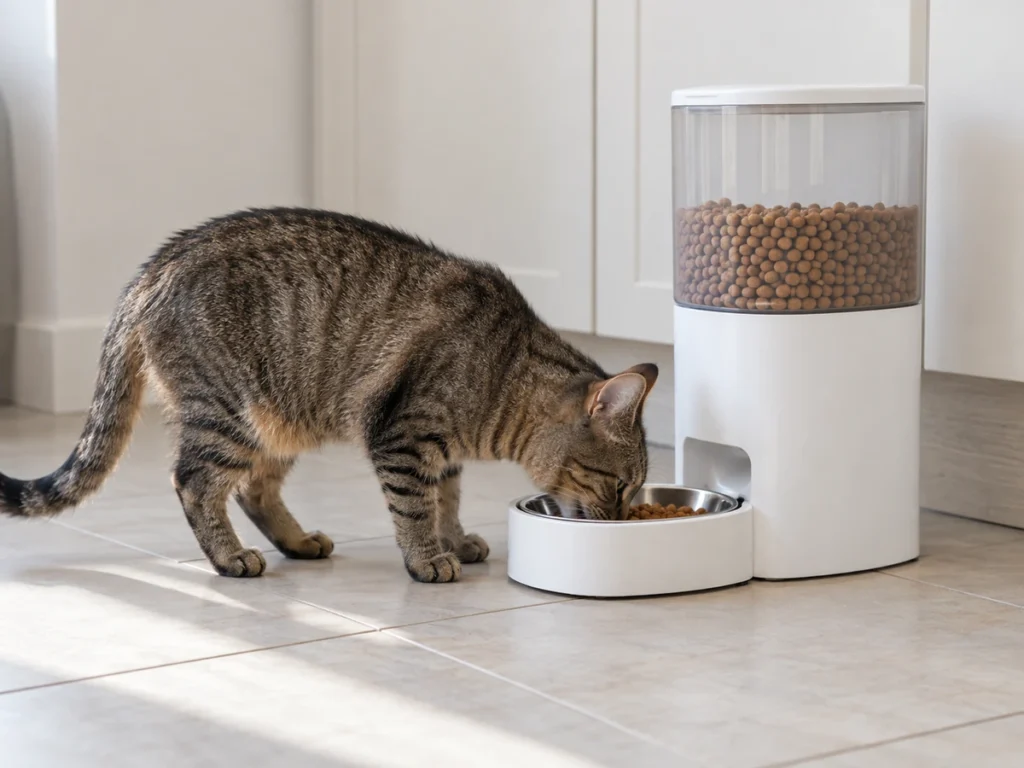
Your vet asks how much the older cat is eating and you realize you have no idea. There are two cats, one bowl, and the honest answer is “some”. That question is what PETLIBRO built the Granary 2 around. A scale under the bowl and a camera above it try to turn “some” into a number, per cat, per meal. The hardware does that well enough on paper. The part worth reading before you buy is the running cost, because the feature that gives the scale its medical value is not included with the feeder, and neither is the consumable you will replace twenty-six times a year.
What the scale under the bowl does
Older smart feeders logged dispensing events. They knew a portion fell, and that was the whole record. If your cat walked away, the log still said the cat was fed.
The Granary 2 puts a scale in the bowl base. PETLIBRO’s own description is specific: “The built-in bowl scale measures food to within 1 g, so you can track what’s dispensed, eaten, and remaining.” That third number is the one that changes anything. Dispensed minus remaining is roughly what went into the cat, and over a two weeks that difference turns into a trend line instead of an anecdote.
On top of that sits an AI camera that identifies which animal is at the bowl and files the meal to the right profile. In a two-cat house, that is the difference between data and noise.
Resolution is not the same as accuracy
Treat the 1 g figure as a resolution claim rather than a guarantee. The scale supports a maximum load of 7.5 kg, so one gram is about one part in seven and a half thousand. That is a fine reading for a kitchen-grade load cell, and load cells drift with temperature, with how the bowl sits, and with a knocked base.
PETLIBRO effectively says as much in its own support notes: “We recommend calibrating the scale each time the feeder is disassembled and reassembled.” You will disassemble it, because you have to wash a bowl a cat eats from. So calibration becomes a routine chore, and skipping it quietly degrades the numbers you are relying on.
One more detail that is easy to miss. The maximum is 6 portions per dispense and a portion is roughly 20 ml or 10 g, about a twelfth of a cup. So the feeder measures in single grams but dispenses in ten-gram steps. Fine control over what leaves the hopper is not what you are buying. Fine measurement of what stays in the bowl is.
The early-warning feature is a subscription
Here is the bit that gets glossed over in coverage of this feeder. The scale is in the box. The alert is not.
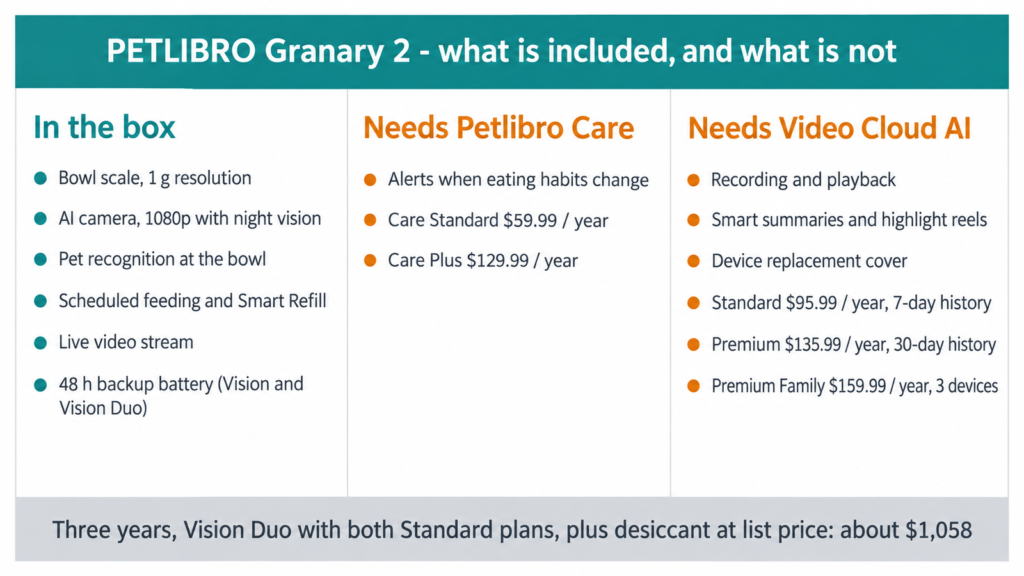
PETLIBRO footnotes its own product page twice. “Petlibro Care subscription required for alerts about changes in eating habits.” And separately: “Video Cloud AI subscription required for recording and playback.”
Read that carefully. Without Petlibro Care you can open the app and look at charts. You will not be told that the fifteen-year-old has dropped from 78 g a day to 61 g over ten days, which is precisely the signal that sends a cat to the vet early enough to matter. Without Video Cloud AI you get a live stream and nothing saved, so you cannot go back and check who was at the bowl at three in the morning.
Subscription prices, plan by plan
PETLIBRO’s own listed annual prices, checked on September 20, 2026, are these. Petlibro Care comes as Care Standard at $59.99 a year and Care Plus at $129.99 a year. Video Cloud AI comes as Standard at $95.99 a year with a 7-day video history, Premium at $135.99 a year with 30 days, and Premium Family at $159.99 a year covering up to three devices. Each paid video tier also bundles free repair or replacement while the subscription is active.
The free video tier gives you live streaming and a beta AI assistant. No stored clips, no daily summaries, no replacement cover.
As for hardware, PETLIBRO lists the Granary 2 at $129.99, the Granary 2 Vision at $189.99 and the Granary 2 Vision Duo at $199.99. The Granary 2 X appears on PETLIBRO’s store at $279.99 and is marked as coming soon. Independent coverage published a day earlier quoted a lower figure for the X, so treat any number below the store price as an introductory offer and check what is actually charged on the day.
The consumable nobody budgets for
The hopper stays dry with desiccant, and PETLIBRO is blunt about the schedule: replace every 14 days, two bags at a time. Do the arithmetic yourself, because it is not on the box.
365 divided by 14 is about 26 changes a year. At two bags per change that is 52 bags. An eight-pack costs $19.99, so 52 bags is 6.5 packs, or about $130 a year at list price. Subscription delivery and first-order discounts bring that down, but the order of magnitude holds: the drying agent costs roughly what the cheapest model of feeder costs, every year.
Three years, added together
Take the Vision Duo at $199.99, add Petlibro Care Standard and Video Cloud AI Standard, and add desiccant at list price.
Hardware is $199.99. Care Standard at $59.99 times three is $179.97, and Video Cloud AI Standard at $95.99 times three is $287.97. Desiccant about $129.94 times three is $389.82. Three-year total: about $1,058.
The subscriptions and consumables come to roughly $858, which is more than four times the price of the feeder. That ratio is the honest summary of this product category, and it is worth knowing before the unboxing. The PETLIBRO Granary 2 Vision Duo is a capable machine. It is also a subscription with a hopper attached.
What it will not do
It is a dry-food feeder only. PETLIBRO specifies kibble between 2 mm and 15 mm and warns against oversized or irregular shapes such as large cubes and crescents. No wet food at all. It wants a hard, flat floor and is not suitable for carpet.
Power loss is handled better than most. The Vision and Vision Duo carry a built-in rechargeable backup rated for up to 48 hours, and PETLIBRO states that Wi-Fi, camera, pet recognition and feeding schedules keep running during an outage, with the backup meant for emergencies only.
Which one, and for whom
If you have one cat and you want reliable meals while you are at work, the plain Granary 2 at $129.99 with no subscription does that job and the scale still shows you charts. Buy nothing else.
For two or more cats, where one of them has a weight or appetite problem you are actively managing, the Vision Duo plus Petlibro Care is the configuration that earns its keep, because the eating-change alert is the reason to own it. Skip the video plan unless you specifically want stored footage.
PETLIBRO could still sell the eating-habit alert on its own, outside the wider Care plan. Until it does, budget for the plan the same way you budget for litter.