PETLIBRO Granary 2 Vision Duo: Specs, Price, Pros & Cons
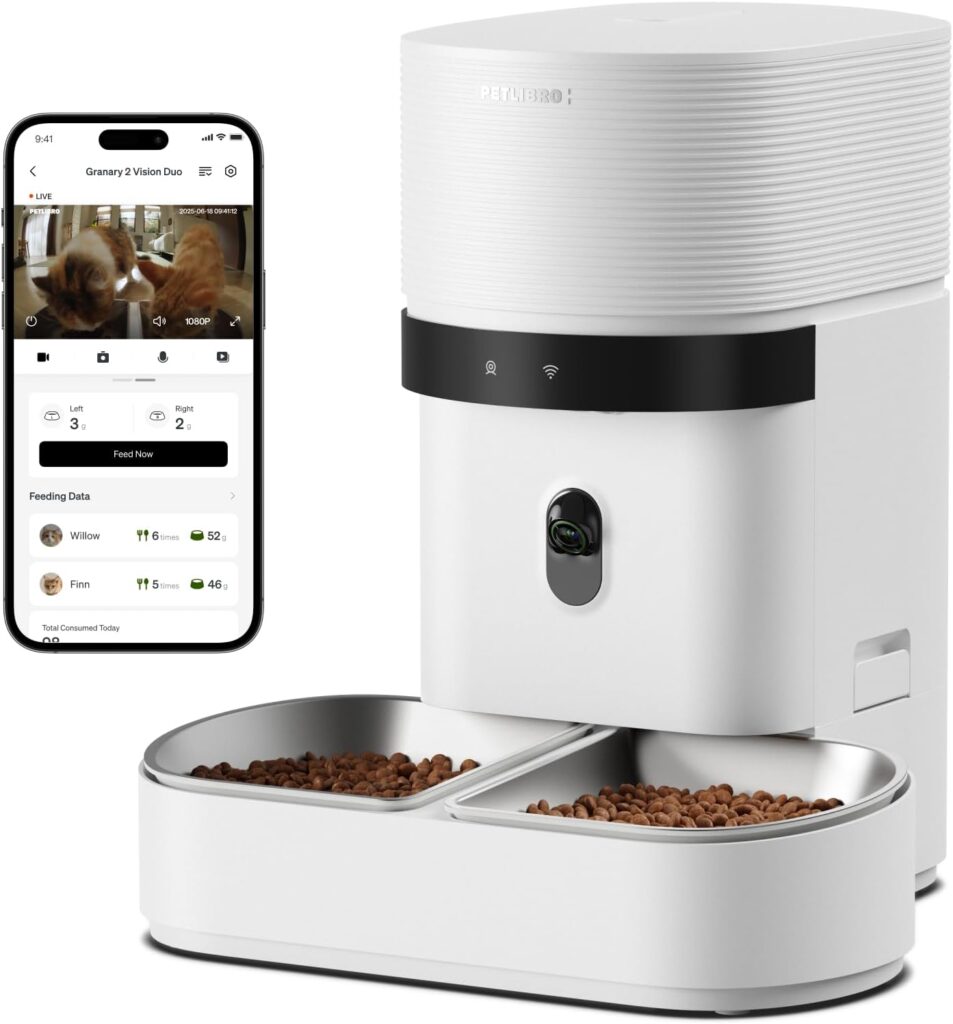
The thing that separates the Granary 2 Vision Duo from every earlier PETLIBRO feeder is under the bowls: two independent scales that weigh what is dispensed, what is eaten and what is left, to the gram. Pair that with a camera that recognizes which pet is at which bowl and the feeder can finally answer the question the older Dual Bowl Granary could not: who ate what, and how much.
That combination reshapes what the product is for. It is less a timer that drops kibble and more a monitoring system for multi-cat homes where intake matters, whether because one cat is on a weight plan, one is elderly and quietly eating less, or a household wants proof that both animals are fed while nobody is home. Smart Refill Mode uses the scales to top up a bowl whenever it drops below a threshold while staying inside a daily limit, which suits grazers. Classic scheduled meals remain for cats that do better on fixed times.
The hardware is a step up as well. Dual food chutes replace the wedge that splits a single stream, the bowls are stainless steel in a lift-out holder, and the backup is a built-in rechargeable battery in place of D cells, keeping Wi-Fi and the camera running for about two days in an outage. The camera records in 1080p with night vision and includes two-way audio.
The limits are real. PETLIBRO lists the feeder for cats only and for hard flat floors, since the scales need a stable surface, and it wants recalibrating whenever it is taken apart. Recording, playback and eating-habit alerts sit behind subscriptions, while live view and the scale data do not. And the price puts it well above the older Granary duos. If you only need two bowls fed on a schedule, that older model does it for far less.
Category strengths
Where the PETLIBRO Granary 2 Vision Duo beats the median
- Has built-in camera ?
- Has dual bowls ?
- Has two-way audio ?
- Has multi-pet recognition ?
How this VS Score was computed
Score 72: each known spec is measured against the median of all smart feeders (10 products), then weighted; 50 means level with that median. In classes of six or more, a value beyond the class’s 10th–90th percentile range counts as that limit, so one extreme product cannot set the scale. 31% of the scoreable weight could be used; unknown values, features not applicable to this class and proxies (battery capacity where a rated life exists) add or remove nothing.
| Specification | This product | Cohort median | Score weight | Points moved |
|---|---|---|---|---|
| Built-in camera | Yes | 40% of the class have it | 0.5 | +25.0 |
| Dual bowls | Yes | 33% of the class have it | 0.3 | +15.0 |
| Two-way audio | Yes | 44% of the class have it | 0.3 | +15.0 |
| Multi-pet recognition | Yes | 38% of the class have it | 0.3 | +15.0 |
| Food capacity | 5 | 5 | 1 | +0.0 |
| Minimum portion | 10 | 10 | 0.4 | +0.0 |
| Backup battery life | 2 | 2 | 0.4 | +0.0 |
Not scored: Meals per day (unknown: not scored); Slow-feed mode (unknown: not scored); Microchip / RFID access (unknown: not scored); Gravity backup (unknown: not scored); Sealed food container (unknown: not scored); Desiccant compartment (standard for the class (88% have it)); Clog detection (unknown: not scored); Anti-pinch sensor (unknown: not scored); Dishwasher-safe parts (unknown: not scored); Stainless steel bowl (standard for the class (89% have it)); Battery backup (standard for the class (100% have it)); App control (standard for the class (90% have it)); Wi-Fi connectivity (standard for the class (90% have it)); 5 GHz Wi-Fi support (standard for the class (80% have it)); Meal call recording (unknown: not scored); Low-food alert (standard for the class (100% have it)); Feeding log (standard for the class (90% have it)); Voice assistant (unknown: not scored).
Editor’s note
I think the scale is the feature that finally justifies a premium smart feeder, and it is a little surprising it took the category this long. Cameras tell you a cat visited the bowl. A scale tells you whether it ate. For anyone who has stood in a kitchen wondering whether the kibble disappeared into the right cat, the per-bowl weight log combined with pet recognition is the first honest answer a feeder has offered. It also changes how you use the machine, because Smart Refill mode turns it from a scheduler into a bowl that keeps itself topped up within a daily budget.
My hesitations are practical. The scales dictate a hard, level floor and a recalibration each time you pull the unit apart to clean it, which is a chore people skip until the numbers drift. The dual-chute design is better than a wedge, but PETLIBRO still only promises near-even distribution, with no separate portion per bowl. Two cats on different diets are still better served by a microchip-gated feeder. And the subscription question hangs over the camera: what you see live is free, what you can go back and watch is not.
Against the older camera Dual Bowl Granary the choice is clear if intake tracking matters and equally clear if it does not. That model feeds two cats for a fraction of the money. Against RFID collar feeders, the Vision Duo wins on convenience and loses on strict per-pet access. The built-in rechargeable backup is a quiet but meaningful upgrade over D cells, because the camera and Wi-Fi stay up during an outage instead of going dark.
I would buy this for a two-cat home with a weight or health concern, or for owners who want intake data more than reassurance. I would not buy it for a single cat, for dogs, or for carpeted rooms, where the scales cannot be trusted.
Specifications
Quality bars show where each figure sits between the lowest and highest of the 10 smart feeders this VS Score is measured against.
Feeding
Freshness & reliability
Power
Smart features
Design
Sources and verification
Where the specifications come from
- Official product pagepetlibro.com
- Retailer listing (cross-check)amazon.com
Verification
- First published
- Specifications last checked
- Sheet completeness
- 20 of 30 specifications verified; the rest show as Unknown and are never estimated or scored
- Page type
- Product specification page — Compiled from the manufacturer’s published specifications and the cited sources; this is not a hands-on test.
- Basis
- Research-based: specifications and editorial text were compiled from the documents listed here and the manufacturer’s published data. We have not tested this unit ourselves; where independent measurements are mentioned they belong to the linked publication.
Where to buy
Prices and availability may change. Check the retailer before buying. We may earn a commission on purchases.
Price history
Smart Feeders with similar specs to the PETLIBRO Granary 2 Vision Duo
Ratings & reviews
No reviews yet. Be the first to share your experience.
The bottom line
The PETLIBRO Granary 2 Vision Duo earns a VS Score of 72 on the 31% of specifications we could compare like for like — an indication, not a ranking.
- Who it’s for
- Two-cat households with a weight, appetite or health concern who want per-cat intake data, not just a video of the bowls.
- Who should look elsewhere
- Single-cat homes, dogs, carpeted rooms, and anyone who needs strictly different portions per pet. The chutes share one plan and the scales need a hard level floor.
- The trade-off that matters
- The scales and recognition deliver real insight, but they arrive with a much higher price, a recalibration chore after every deep clean, and subscription gates on recorded video.
- The main alternative
- PETLIBRO Granary Smart Camera Feeder Dual Bowl: the same two-bowl job with a camera and none of the weighing, for far less money.
The VS Score is calculated from the weighted specifications above, each measured against the median of comparable smart feeders — a shortlisting guide, not a substitute for your own priorities. See how we score.