PETLIBRO Polar Smart Wet Food Feeder: Specs, Pros & Cons
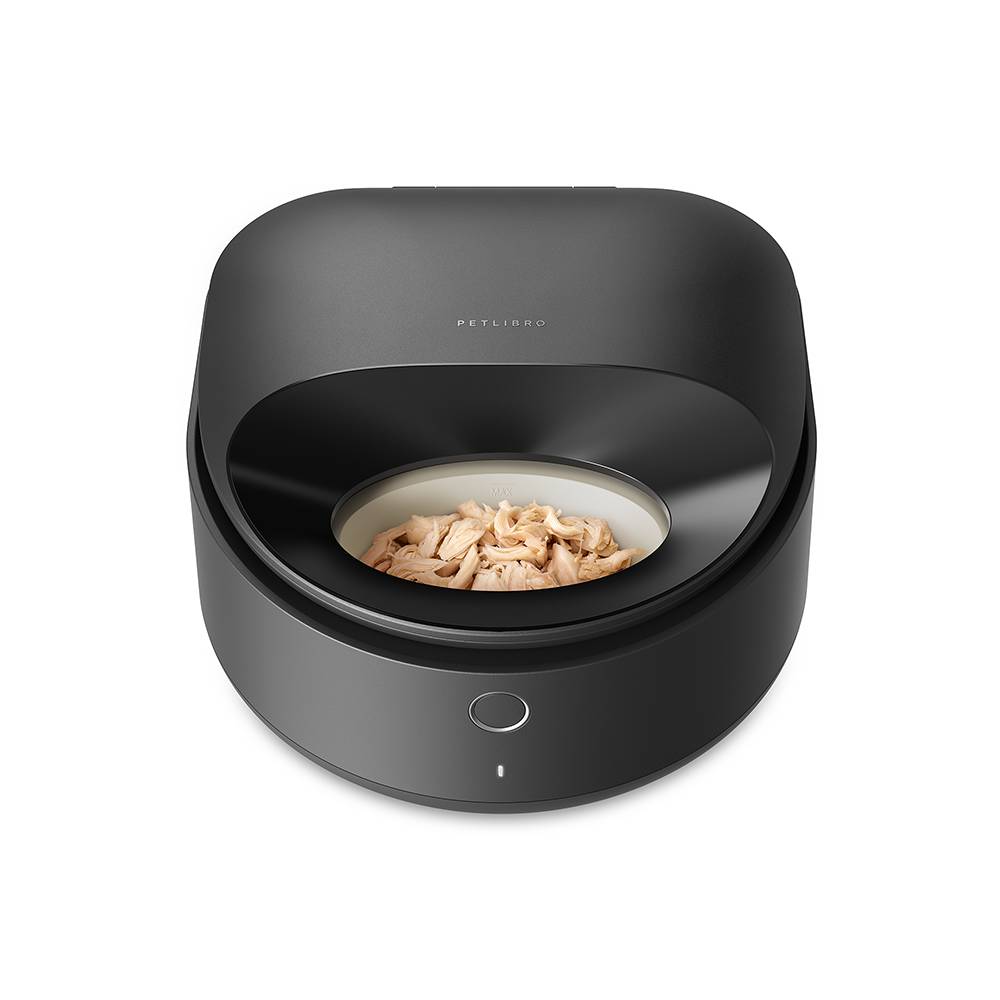
Almost every automatic feeder on the market is a kibble hopper. The PETLIBRO Polar is one of the very few built around canned and pouch food: a lidded, refrigerated carousel that keeps wet meals chilled with a thermoelectric cooling plate and rotates the next tray into the opening when the schedule says so. Within PETLIBRO's own range it sits apart from the Granary dry-food feeders and the RFID-gated One, and it is priced accordingly.
The idea is simple and the execution is fairly careful. Cooling pauses for a while before each meal so the food is not served fridge-cold, the lid has a sensor that stops it closing on a curious head, and the app sets not just a time but a feeding window, so leftovers are covered again when it ends. PETLIBRO also says it will take freeze-dried food that has been rehydrated, but explicitly asks you not to use it for raw diets.
Its limitations follow from the design. A tray carousel holds a handful of meals, which covers a long weekend but not a holiday. Cooling is rated for ordinary room temperatures and will struggle in a hot conservatory. The opening height makes it a cat product: PETLIBRO gives a minimum shoulder height and no dog recommendation. Wi-Fi is 2.4 GHz only, and while there is a battery backup it only keeps the schedule alive for part of a day, so this wants a permanent mains socket.
Who it suits is clear: a household that feeds wet food on a schedule and is tired of the choice between leaving a tin out to dry or asking someone to come round. If your cat eats kibble, the cooling you are paying for is irrelevant and a hopper feeder does the job for much less.
Category strengths
Where the PETLIBRO Polar Smart Wet Food Feeder trails the median
- A much lower meals per day ?3 vs 10 (median)
- A much lower backup battery life ?0.5 days vs 2 days (median)
- No desiccant compartment ?
- No stainless steel bowl ?
- No 5 GHz Wi-Fi support ?
How this VS Score was computed
Score 18: each known spec is measured against the median of all smart feeders (10 products), then weighted; 50 means level with that median. In classes of six or more, a value beyond the class’s 10th–90th percentile range counts as that limit, so one extreme product cannot set the scale. 31% of the scoreable weight could be used; unknown values, features not applicable to this class and proxies (battery capacity where a rated life exists) add or remove nothing.
| Specification | This product | Cohort median | Score weight | Points moved |
|---|---|---|---|---|
| Built-in camera | No | 40% of the class have it | 0.5 | −24.0 |
| Dishwasher-safe parts | Yes | 60% of the class have it | 0.3 | +15.0 |
| Backup battery life | 0.5 | 2 | 0.4 | −14.8 |
| Dual bowls | No | 33% of the class have it | 0.3 | −14.4 |
| Desiccant compartment | No | 88% of the class have it | 0.3 | −14.4 |
| Stainless steel bowl | No | 89% of the class have it | 0.3 | −14.4 |
| Two-way audio | No | 44% of the class have it | 0.3 | −14.4 |
| Meals per day | 3 — capped at the class’s lower range (6) | 10 | 0.6 | −12.0 |
| 5 GHz Wi-Fi support | No | 80% of the class have it | 0.2 | −9.6 |
Not scored: Food capacity (unknown: not scored); Minimum portion (unknown: not scored); Slow-feed mode (unknown: not scored); Microchip / RFID access (unknown: not scored); Gravity backup (unknown: not scored); Sealed food container (unknown: not scored); Clog detection (unknown: not scored); Anti-pinch sensor (too few comparable peers (1, need 3)); Battery backup (standard for the class (100% have it)); App control (standard for the class (90% have it)); Wi-Fi connectivity (standard for the class (90% have it)); Meal call recording (unknown: not scored); Low-food alert (unknown: not scored); Feeding log (standard for the class (90% have it)); Multi-pet recognition (unknown: not scored); Voice assistant (unknown: not scored).
Editor’s note
The cooling is the entire argument for this feeder, so it is worth being precise about what PETLIBRO claims. In its own testing at a normal room temperature the compartment holds food at roughly fridge temperature, and the company rates the stored meals for up to 72 hours. That is a real step beyond the ice-pack feeders in this category, which keep a chill for a few hours and then become an ordinary open tray. It is not a fridge, though: PETLIBRO specifies a room temperature band for it to work well, warns that condensation collects in the cooling area and needs wiping, and asks for a weekly clean of the bowl seat because wet food attracts ants. Buyers who want a set-and-forget appliance should read that as a maintenance schedule.
Each tray holds about 220 mL, roughly one large can or two pouches, so a cat on two wet meals a day gets a day and a half of cover from a full load. That is fine for a late night at work or a weekend away. A week-long trip still needs a sitter.
The version choice matters more than it looks. The base model comes with a plastic bowl and the stainless-steel bowl costs noticeably more. Both are dishwasher-safe, but if you have a cat prone to chin acne, or you prefer metal against food, the upgrade is the one place I would spend extra.
Where I would hesitate is a multi-cat household. There is one opening, no pet recognition and no way to keep one cat's prescription diet away from the other, so the Polar assumes the cat in front of it is the one you meant. Two cats on identical food is fine. Two diets is not. And the 12-hour battery backup keeps meals coming through a power cut but does not make this portable in any sense.
Specifications
Quality bars show where each figure sits between the lowest and highest of the 10 smart feeders this VS Score is measured against.
Feeding
Freshness & reliability
Power
Smart features
Design
Sources and verification
Where the specifications come from
- Official product pagepetlibro.com
Verification
- First published
- Specifications last checked
- Sheet completeness
- 19 of 30 specifications verified; the rest show as Unknown and are never estimated or scored
- Page type
- Product specification page — Compiled from the manufacturer’s published specifications and the cited sources; this is not a hands-on test.
- Basis
- Research-based: specifications and editorial text were compiled from the documents listed here and the manufacturer’s published data. We have not tested this unit ourselves; where independent measurements are mentioned they belong to the linked publication.
Where to buy
Prices and availability may change. Check the retailer before buying. We may earn a commission on purchases.
Price history
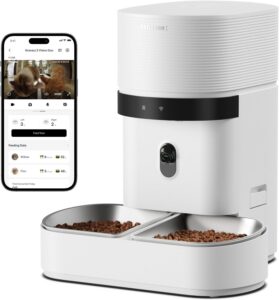
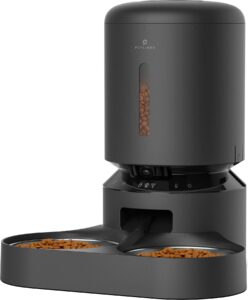
Smart Feeders with similar specs to the PETLIBRO Polar Smart Wet Food Feeder
Ratings & reviews
No reviews yet. Be the first to share your experience.
The bottom line
The PETLIBRO Polar Smart Wet Food Feeder earns a VS Score of 18 on the 31% of specifications we could compare like for like — an indication, not a ranking.
- Who it’s for
- A one- or two-cat household that feeds canned or pouch food on a schedule and wants to leave for a weekend without asking a neighbor to open tins.
- Who should look elsewhere
- Multi-cat homes that need each cat to get its own diet, anyone feeding raw, and kibble feeders. A dry-food hopper does the same scheduling job for far less.
- The trade-off that matters
- Three trays is the ceiling. It buys about three days of chilled, portioned wet food and not a day more, so anything past a long weekend still needs a cat-sitter.
- The main alternative
- Catit PIXI Smart 6-Meal Feeder: six compartments and a lower price, but it cools with freezer packs that fade within hours rather than active refrigeration.
The VS Score is calculated from the weighted specifications above, each measured against the median of comparable smart feeders — a shortlisting guide, not a substitute for your own priorities. See how we score.