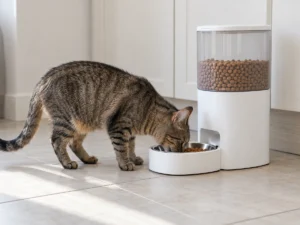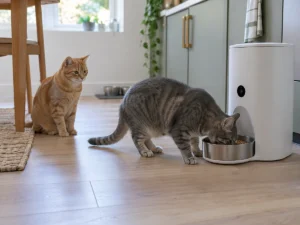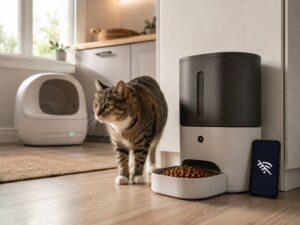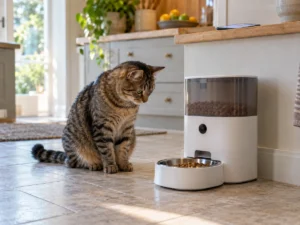
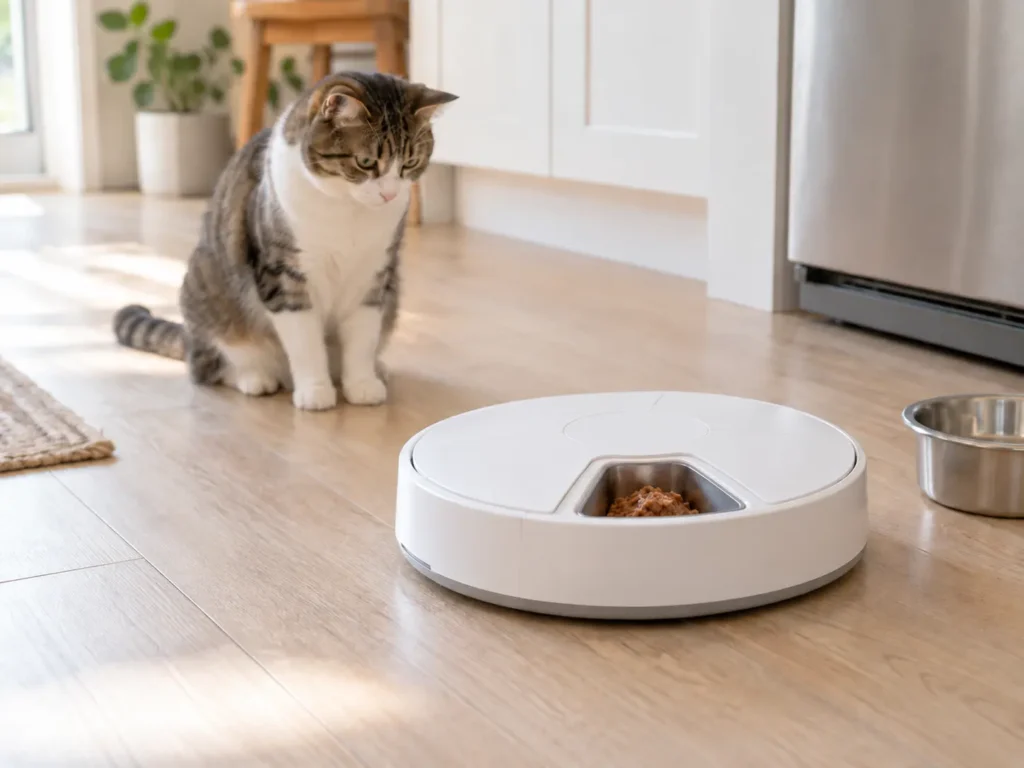
Almost every automatic feeder on the market is a kibble hopper. Dry food tolerates sitting in a plastic container for a week, so the engineering problem is portion control and jam prevention. Wet food is a different proposition entirely. It is moist, it is protein-rich, and it starts changing the moment the tin is opened. So an automatic wet food feeder has to solve a problem the dry-food category never faces, and the way each design solves it decides how long the food stays acceptable.
What the official guidance says
Start with the primary source. The United States Food and Drug Administration publishes handling guidance for pet food and treats, last updated on May 23, 2024. Its instruction on canned and pouched food is short: promptly refrigerate or throw out unused or leftover portions. It sets the refrigerator itself at 40 degrees Fahrenheit or below, tells owners to wash bowls and utensils with soap and hot water after each use, and keeps dry food storage below 80 degrees Fahrenheit.
Notice what is missing. That guidance does not state how long wet food may sit out in a bowl before it must be discarded. Numbers circulate widely online, and some of them may be sensible, but no primary source gives a specific safe out-of-refrigerator duration for wet pet food. Treat any feeder marketing that implies an official time limit with caution.
What the FDA guidance does establish is the direction of travel. Cold is the control, and the bowl is not a storage location.
Two ways a feeder keeps food cold
The cheaper approach puts a frozen gel pack in a chamber beneath the food trays. It works, and it works for a while. Cold stored in a pack is a finite quantity, so once it has absorbed enough heat from the room the chamber warms up and the feeder becomes an ordinary open tray. Owners who load one at eight in the morning for a six in the evening meal are relying on the last hours of a fading store.
The more capable approach uses a thermoelectric cooling plate powered from the mains. A thermoelectric module moves heat rather than storing cold, so it holds a roughly fixed temperature difference below whatever the surrounding room is doing. That is the crucial detail. Its performance is defined relative to ambient conditions.
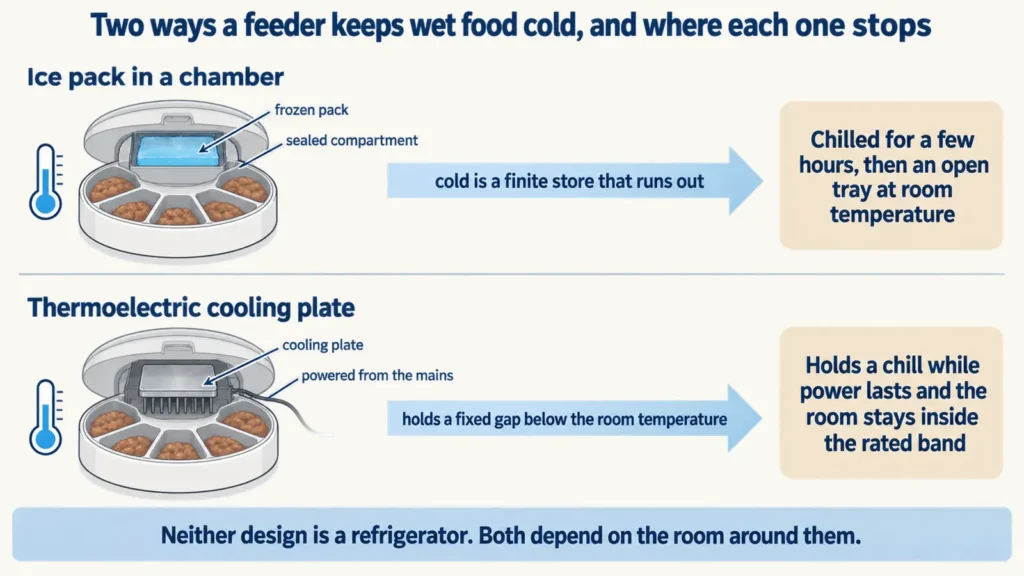
That is why manufacturers specify a room-temperature band for these products, and why the specification is not small print. Put a thermoelectric feeder in a hot conservatory in July and it will fall behind. Put it in a normally heated room and it performs as described.
Reading a 72-hour claim properly
The PETLIBRO Polar Smart Wet Food Feeder is a useful worked example, because the company is unusually specific about its own testing. PETLIBRO says that in its testing at a normal room temperature the compartment holds food at roughly refrigerator temperature, and it rates stored meals for up to 72 hours.
That claim carries three conditions worth reading in full. It assumes a normal room temperature, so a hot room invalidates it. It assumes mains power throughout, so a long outage invalidates it. And it describes food sealed inside the cooled carousel, so food already rotated into the open serving position falls outside it.
The design details around it are sensible. Cooling pauses for a period before each meal so the food is not served refrigerator-cold, which matters because many cats refuse very cold food. A lid sensor stops the mechanism closing on a curious head. The app sets a feeding window with an end as well as a start time, so uneaten food gets covered again instead of drying out in the open.
Maintenance is part of the same picture. PETLIBRO warns that condensation collects in the cooling area and needs wiping, and asks for a weekly clean of the bowl seat, because wet food attracts ants.
Capacity is smaller than owners expect
A tray in this class holds roughly 220 milliliters, which is about one large tin or two pouches. So a cat on two wet meals a day gets somewhere near a day and a half of coverage from a full load.
That is useful for a late night at work or a weekend away. It is not a substitute for a sitter on a week-long trip, and no amount of app scheduling changes the arithmetic. Anyone shopping for holiday cover should count trays before reading feature lists.
Where these feeders stop working
Multi-cat households are the clearest limit. A single serving opening with no pet recognition means the feeder assumes the animal standing in front of it is the intended one. Two cats on identical food is fine. Two cats where one is on a prescription diet is not, and no scheduling feature fixes that.
Raw diets are another. The Polar accepts rehydrated freeze-dried food but its maker explicitly asks owners not to use it for raw.
Power matters too. Battery backup on these feeders typically keeps the schedule and the clock alive for part of a day. It does not run the cooling plate. A long outage means the cooling stops even if the meals still rotate on time, which is the worse of the two failures.
A short pre-purchase checklist
- Does the cooling run from the mains, or from a consumable ice pack?
- What room-temperature range does the maker specify, and does your kitchen stay inside it in summer?
- How many trays does it hold, and how many meals a day does your cat eat?
- Does the lid close over uneaten food after the feeding window?
- Which parts are dishwasher safe, and how often does the maker want the bowl seat cleaned?
- What does the backup battery keep running during a power cut?
Answer those six questions before comparing prices. The cooling system is the entire reason this category costs more than a kibble hopper, so it deserves most of the attention.