PETLIBRO One RFID Smart Feeder: Specs, Price, Pros & Cons
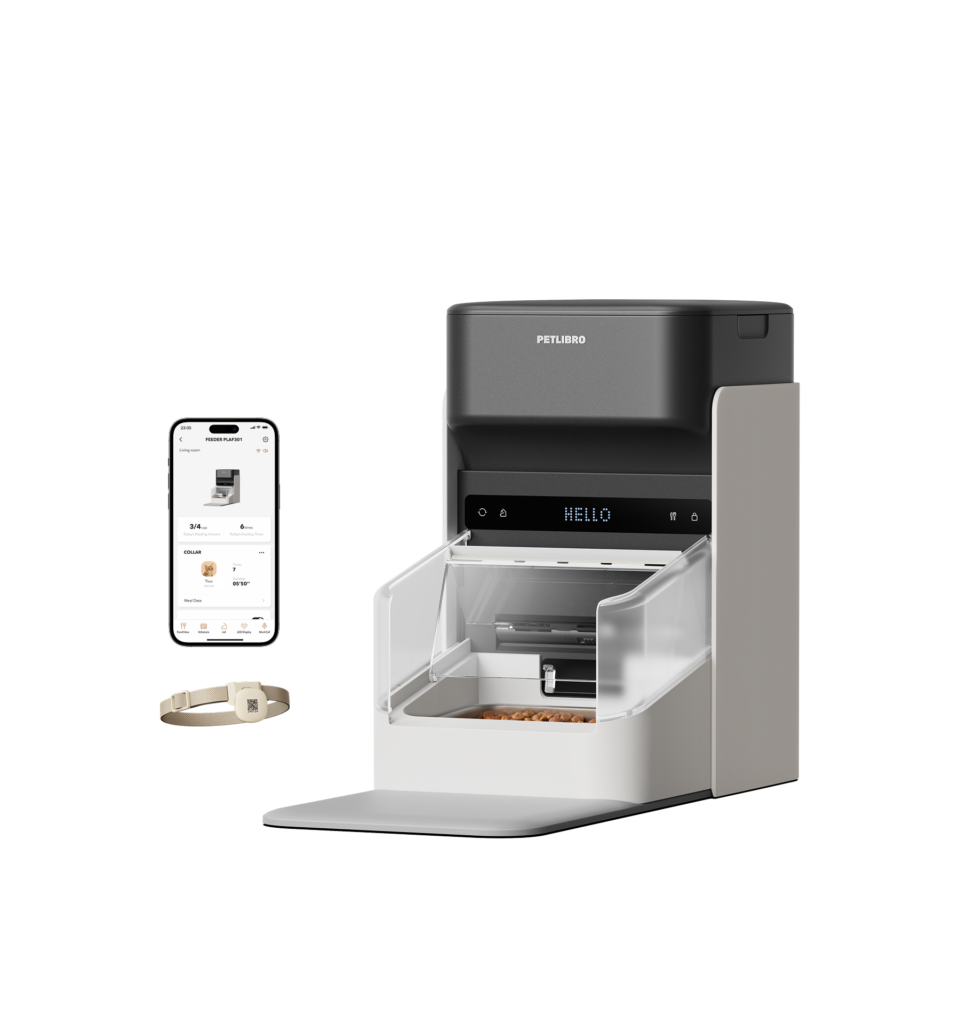
PETLIBRO's One RFID keeps the food locked away until the right cat walks up wearing the right tag. A reader mat under the bowl checks a small collar tag, and only then does the bowl lid swing open, so a greedy housemate or a cat on a different diet stays out of the dish.
The tag is the defining choice, and the limit to know first. It is PETLIBRO's own collar tag, light, splashproof and battery-free, and the feeder will not read an implanted microchip or another brand's tag. Each feeder pairs with one tag only. A three-cat house with three separate diets needs three feeders, spaced at least 25 cm apart so their readers do not interfere with each other.
Around the lock sits an ordinary dry-food dispenser: a scheduled hopper, a stainless bowl, app control over Wi-Fi on either band, and a sensor that flags a blocked outlet. The tank lid clips shut on both sides, which should frustrate a cat that learns to raid the hopper from above. Kibble has to measure between 2 and 15 mm. Wet food, semi-moist food and supplements are ruled out by the manual.
It makes the most sense in a home where one cat is on a prescription or weight-loss diet and another keeps finishing it. A single cat with no rival at the bowl gains nothing from the reader, and the PETLIBRO Granary Smart Feeder handles the scheduling half for far less. The One RFID is priced well above PETLIBRO's plain feeders, and buying one per protected cat multiplies that gap, so the decision rests on how much the food theft is costing in vet visits or weight.
Category strengths
Where the PETLIBRO One RFID Smart Feeder trails the median
- A lower food capacity ?3 L vs 5 L (median)
How this VS Score was computed
Score 28: each known spec is measured against the median of all smart feeders (10 products), then weighted; 50 means level with that median. In classes of six or more, a value beyond the class’s 10th–90th percentile range counts as that limit, so one extreme product cannot set the scale. 32% of the scoreable weight could be used; unknown values, features not applicable to this class and proxies (battery capacity where a rated life exists) add or remove nothing.
| Specification | This product | Cohort median | Score weight | Points moved |
|---|---|---|---|---|
| Built-in camera | No | 40% of the class have it | 0.5 | −24.0 |
| Food capacity | 3 | 5 | 1 | −20.0 |
| Dishwasher-safe parts | Yes | 60% of the class have it | 0.3 | +15.0 |
| Dual bowls | No | 33% of the class have it | 0.3 | −14.4 |
| Two-way audio | No | 44% of the class have it | 0.3 | −14.4 |
| Multi-pet recognition | No | 38% of the class have it | 0.3 | −14.4 |
| Meals per day | 10 | 10 | 0.6 | +0.0 |
Not scored: Minimum portion (unknown: not scored); Slow-feed mode (unknown: not scored); Microchip / RFID access (too few comparable peers (2, need 3)); Gravity backup (unknown: not scored); Sealed food container (unknown: not scored); Desiccant compartment (standard for the class (88% have it)); Clog detection (standard for the class (100% have it)); Anti-pinch sensor (unknown: not scored); Stainless steel bowl (standard for the class (89% have it)); Battery backup (standard for the class (100% have it)); Backup battery life (unknown: not scored); App control (standard for the class (90% have it)); Wi-Fi connectivity (standard for the class (90% have it)); 5 GHz Wi-Fi support (standard for the class (80% have it)); Meal call recording (unknown: not scored); Low-food alert (standard for the class (100% have it)); Feeding log (standard for the class (90% have it)); Voice assistant (unknown: not scored).
Editor’s note
The feeder is only as reliable as the collar. PETLIBRO ships a snap-release collar, which is the right safety choice and also the reason a tag can end up under the sofa. When that happens the lid stays shut and the cat goes without, so I would watch the app's per-visit log for the first few weeks. A missing visit is how you will find out.
Power is better thought through than on most feeders. A 5V adapter runs it, and three D-cell alkaline batteries, bought separately, carry it through a cut. PETLIBRO's own documents disagree on what survives. The manual says the reader, Wi-Fi and the meal schedule all keep working on batteries, while the FAQ on the product page says Wi-Fi switches off to save power. Meals continue either way. Remote alerts during an outage are the part I would not rely on.
Space is the cost nobody prices in. The reader mat sits in front of the body, so the feeder is deep for its height, and PETLIBRO asks for a gap between neighboring units and a smaller one from any of its Dockstream fountains. Two cats on separate diets become a line of hardware along one wall.
The app splits along a paywall. Schedules, the lid, the name on the dot display and the feeding log are free. Trend charts, goal tracking and multi-pet records sit in the paid Petlibro Care plans, an odd place for multi-pet features on a product built for multi-pet homes.
Upkeep is light but recurring. Only the stainless bowl is dishwasher safe, the body wipes clean, and the desiccant bag under the lid should be swapped every two weeks, a small standing order on top of the food.
On a cat that keeps its collar on, the lock solves the one problem a plain schedule feeder cannot.
Specifications
Quality bars show where each figure sits between the lowest and highest of the 10 smart feeders this VS Score is measured against.
Feeding
Freshness & reliability
Power
Smart features
Design
Sources and verification
Where the specifications come from
- Official product pagepetlibro.com
- Datasheet or manualcdn.shopify.com
- Independent testingcats.com
- Retailer listing (cross-check)petsmart.com
Verification
- First published
- Specifications last checked
- Sheet completeness
- 22 of 30 specifications verified; the rest show as Unknown and are never estimated or scored
- Page type
- Product specification page — Compiled from the manufacturer’s published specifications and the cited sources; this is not a hands-on test.
- Basis
- Research-based: specifications and editorial text were compiled from the documents listed here and the manufacturer’s published data. We have not tested this unit ourselves; where independent measurements are mentioned they belong to the linked publication.
Where to buy
Prices and availability may change. Check the retailer before buying. We may earn a commission on purchases.
Price history
Smart Feeders with similar specs to the PETLIBRO One RFID Smart Feeder
Ratings & reviews
No reviews yet. Be the first to share your experience.
The bottom line
The PETLIBRO One RFID Smart Feeder earns a VS Score of 28 on the 32% of specifications we could compare like for like — an indication, not a ranking.
- Who it’s for
- A home with two or more cats where one is on a prescription or weight-control diet, and the cat being protected will happily wear a collar.
- Who should look elsewhere
- Cats that slip or refuse collars, since the feeder reads only its own tag and never a microchip. Skip it as well for wet food, or for a single cat with nobody stealing its meals.
- The trade-off that matters
- Protection works per feeder and per tag, so every cat on its own diet needs its own unit and its own patch of floor. Cost and clutter grow with the household.
- The main alternative
- SureFeed Microchip Pet Feeder Connect: it reads the implanted microchip, so no collar is needed, though you fill the bowl by hand and there is no scheduled hopper.
The VS Score is calculated from the weighted specifications above, each measured against the median of comparable smart feeders — a shortlisting guide, not a substitute for your own priorities. See how we score.