Review · Smart Feeders

PETLIBRO One RFID Smart Feeder Review: One Tag per Feeder, One Cat per Bowl

Each PETLIBRO One RFID feeder can be linked to one collar tag, and no more. PETLIBRO says so in its own pre-sale answers, and it decides how the feeder works in a home with more than one cat. It is not a shared feeder that tells cats apart. It is a private feeder for one cat, and each other cat in the house gets its own unit and tag.

That puts it in a small group of access-controlled feeders. Sure Petcare's SureFeed Microchip Pet Feeder reads a cat's implanted chip and needs no collar. PETLIBRO's own Granary feeders dispense on a schedule but cannot keep a second cat away.

Nobody here used one, so the assessment rests on PETLIBRO's specifications, manual and support pages, Cats.com's review in which three cats used it, and the patterns in owner comments.

Buy it to keep a cat on a diet or a prescription food away from the others, if that cat will wear a collar. Skip it if the reason is a cat that refuses collars, because the reader ignores microchips.
By Published Research-based assessment

Affiliate disclosure: the price links on this page may earn us a commission at no extra cost to you. Retailers cannot pay for placement or influence the score. How we stay independent

Quick verdict

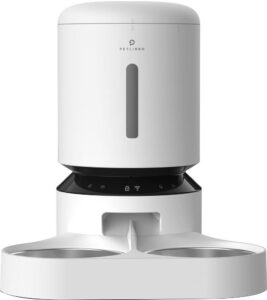
PETLIBRO One RFID Smart Feeder (model PLAF301, white, single pack)
PETLIBRO One RFID Smart Feeder specifications
6.5/10
Editorial ratingFairWeighted average of 5 rated sections.

Buy it if one cat in a multi-cat home needs its own food and will wear a collar: the bowl stays covered until that cat's tag is on the reader. Skip it if you hoped one feeder would serve every cat, because each unit pairs with a single tag and the price multiplies with each cat.

Strengths

  • The bowl stays covered until the paired cat's tag is on the reader
  • No subscription needed for schedules, the lid or the feeding log
  • Backup D batteries keep meals going in a power cut

Weaknesses

  • One tag per feeder, so each cat needs its own unit
  • Ignores microchips
  • A second cat can eat while the lid is open, and commenters under Cats.com's review report cats prying the lid off

Key specifications

Model
PETLIBRO One RFID Smart Feeder, PLAF301 (white PL-AF301-07L, black PL-AF301-08B)
Access control
RFID collar tag, one tag per feeder. Does not read microchips or other brands' tags
Tag
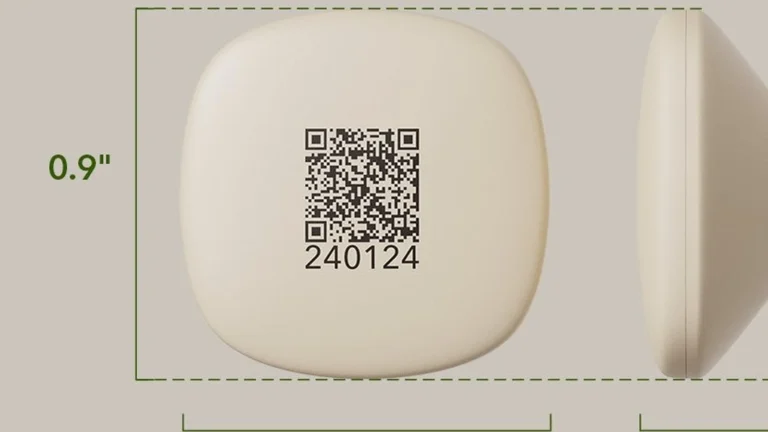
4.2 g, 0.9 x 0.9 x 0.55 in, splashproof, no charging, QR code, snap-release collar
Hopper
3 L (about 13 cups), dry food only, kibble 2 to 15 mm
Meals
Up to 10 a day, scheduled in the PETLIBRO app
Bowl
Stainless steel, dishwasher safe. Rest of the feeder wipe-clean only
Sensors
Infrared sensors for the pet, the food level and outlet blockages
Power
Mains adapter, plus 3 x alkaline D batteries as backup (not included)
Wi-Fi
2.4 GHz and 5 GHz. iOS 13 or later, Android 7 or later
Size and weight
442 x 196 x 320 mm on the product page (449 mm wide in the manual), 2.8 kg
Spacing
At least 10 in (25 cm) between One feeders, 5.9 in from a Dockstream fountain
Warranty
24 months (PETLIBRO)
Subscription
Optional PETLIBRO Care plans for wellness charts and device replacement

Full specification sheet and comparisons →

How we reviewed it

Basis
Research-based: assessed from the manufacturer’s published specifications, documentation and the independent sources listed at the end. We have not tested this unit ourselves; any measurement quoted belongs to the cited source.
Method

Capacity, kibble size, power, box contents and the tag specifications were read from PETLIBRO's product page and the PLAF301 user manual. The one-tag-per-feeder rule, microchip incompatibility, lid behavior when blocked and battery operation come from PETLIBRO's pre-sale answers and support pages. Day-to-day behavior comes from Cats.com's review, written after three cats used the feeder. Owner comments under that review and an access-control roundup from July 2026 were read for recurring patterns and comparisons with Sure Petcare's microchip feeder. Section scores weigh what those facts mean for a household with more than one cat.

Evidence

PETLIBRO documents the access rules, the lid's safety behavior and the battery mode. Cats.com is the only published review found whose writer set the feeder up for real cats, three of them. Owner comments describe cats lifting the lid off its hinge and slow lid closing, which are reported experiences, not measured rates.

Limitations

Nobody has measured portion accuracy, lid closing times or how often an untagged cat gets food. The Cats.com review dates from May 2024, and PETLIBRO has updated the feeder's firmware and listings since. PETLIBRO's manual and its website disagree on whether Wi-Fi stays on during battery operation.

One feeder per cat, by design

7.0/10Good
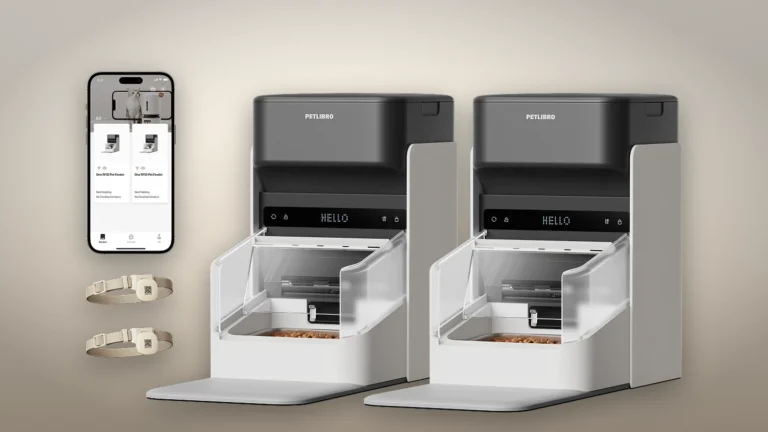
Two white PETLIBRO One RFID feeders side by side with two collar tags and a phone showing the PETLIBRO app
Product illustration based on manufacturer imagery: PETLIBRO's two-pack render of the One RFID feeder on a generated backdrop. Each feeder pairs with one of the two tags. Product illustration based on manufacturer imagery (PETLIBRO render)

The feeder pairs with a single collar tag. PETLIBRO's product page says it plainly in its FAQ, and the pre-sale answers repeat it: each feeder can be linked to one collar, and spare tags are sold separately. So the tagged cat owns that bowl, and every other cat is locked out of it.

That solves a specific problem well. A cat on a weight plan, a renal diet or a prescription kibble can eat its own food on its own schedule while a greedy housemate is kept away. It does not solve the other common problem, a shared feeder that hands each cat a different portion. For that, two cats need two feeders and two tags, and PETLIBRO sells the feeder in two-packs and three-packs for exactly this reason.

Placement follows from it. PETLIBRO asks for at least 10 inches (25 cm) between One feeders and 5.9 inches between a feeder and a Dockstream fountain, because the reader mats can interfere with each other. Its support page lists nearby metal and electronics as the first suspect when the lid closes slowly, so a row of feeders along a kitchen wall needs some planning.

A collar tag, not the microchip

6.0/10Fair
The beige PETLIBRO RFID collar tag from the front with its QR code, and in profile, with a 0.9 inch dimension line
PETLIBRO's tag image, cropped and enlarged. The dimension marks are PETLIBRO's own. PETLIBRO product imagery

The reader works only with PETLIBRO's own tag. It does not read implanted microchips or tags from other brands. That is the difference from Sure Petcare's SureFeed, which reads the chip a cat already has, and it means the cat has to wear a collar every day.

The tag itself is small and needs no charging. PETLIBRO lists it at 4.2 g, about 0.9 by 0.9 by 0.55 inches, splashproof but not for submerging, on a snap-release collar. It carries a QR code that can hold your contact details. Cats.com's reviewer still found it a little bulky for a cat, and pointed out the catch with any breakaway collar: when the collar opens, the tag goes with it, and the cat loses access to its food until you find both.

For a cat that will not tolerate a collar, this feeder cannot work. Our guide to what a microchip can and cannot do explains why the chip a vet implanted is a different technology from an active tag.

How well the lid keeps other cats out

5.5/10Mediocre
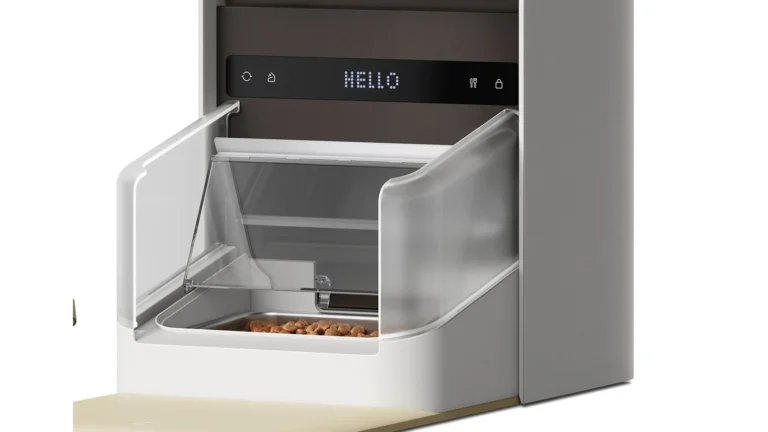
Close view of the PETLIBRO One RFID feeder's open bowl lid, the clear side shields, the stainless bowl with kibble and the control strip showing HELLO
PETLIBRO's product render of the white One RFID feeder, cropped and enlarged. The pixels are unmodified. PETLIBRO product imagery

The bowl sits under a hinged lid with clear shields on both sides. When the tagged cat steps onto the reader mat, the lid opens. It closes when the tag leaves the reader's range, and an infrared sensor stops it from closing on a head or a paw: if something blocks it, the lid reopens briefly and tries again, and after three failed attempts the app sends a notification.

That safety behavior is also the gap. A second cat that pushes in while the first is eating, or arrives the moment the lid starts to close, can reach the food, and the feeder has no mode that shuts the bowl against an approaching untagged cat. Cats.com found the closing speed a little inconsistent without calling it a real problem. Several commenters under that review describe something worse: lids that took many seconds to close, and young cats that learned to pull the lid off its hinge within a day.

Treat it as a strong deterrent, then, and set your expectations by the cats you have. A determined, food-motivated cat is exactly the case where it is weakest.

Schedules, logs and the optional Care plan

7.5/10Good
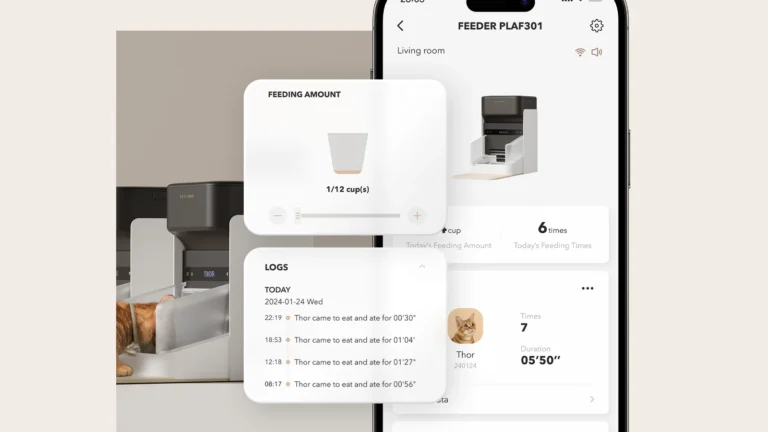
PETLIBRO app screens for the PLAF301 feeder showing the feeding amount slider set to 1/12 cup, today's feeding count and a log of visits by a cat named Thor
PETLIBRO's own app image for the One RFID feeder, cropped. The app shows the feeder in its dark color, and the cat's name and data are PETLIBRO's sample. PETLIBRO app imagery

Setup runs through the PETLIBRO app. The manual warns that a second app, PETLIBRO LITE, sits next to it in the stores and is the wrong one. The feeder takes up to 10 meals a day, and Cats.com found portions as small as 1/12 cup and called the app easy to navigate. Each visit to the bowl shows up in the log with a time and how long the cat ate, which is the part a vet will ask about.

The feeder works without a subscription. PETLIBRO Care is an add-on with trend charts, goal setting, multi-pet dashboards and device replacement, sold in a Standard plan for one pet and a Plus plan for several. Nothing in PETLIBRO's documentation makes schedules or the lid depend on it.

Power cuts, cleaning and kibble size

7.0/10Good
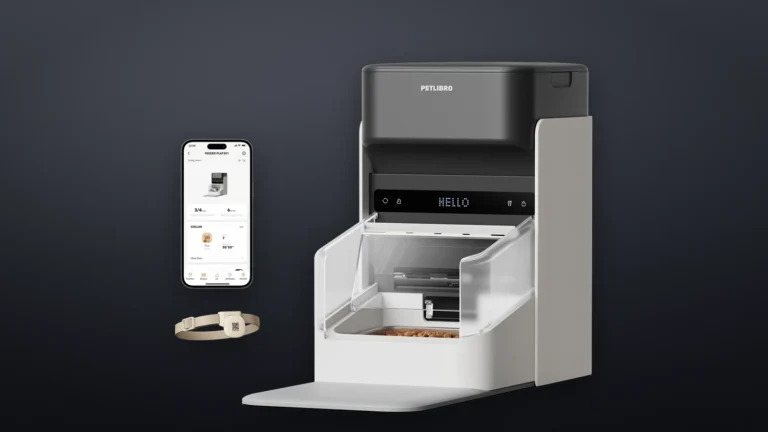
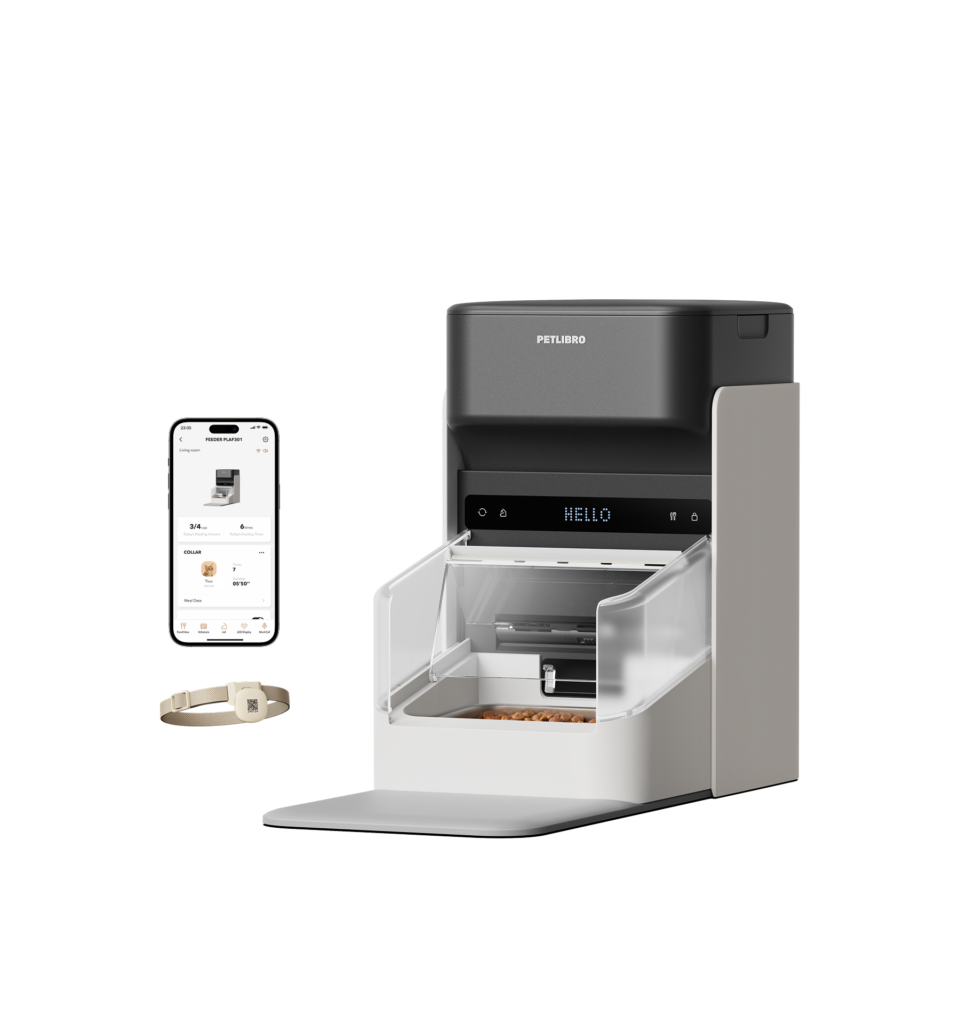
White PETLIBRO One RFID feeder seen from the front left with its reader mat, a collar tag and a phone, on a dark neutral backdrop
Product illustration based on manufacturer imagery: PETLIBRO's render of the white One RFID feeder on a generated backdrop. Product illustration based on manufacturer imagery (PETLIBRO render)

Three alkaline D batteries, not included, keep meals going through a power cut. PETLIBRO says not to use rechargeables or to run on batteries alone. Its website and FAQ say Wi-Fi switches off in battery mode while schedules continue, and the manual says the RFID, Wi-Fi and feeding functions stay on. Plan for the cautious version. Our piece on smart feeders when the internet drops covers what keeps working.

Only the stainless bowl goes in the dishwasher. The base gets a damp cloth, and the desiccant bag under the lid is due every 14 days. The 3-liter hopper takes dry kibble from 2 to 15 mm, and PETLIBRO suggests the feeder for cats and small dogs.

Alternatives worth considering

Where to buy

In-stock offers for this exact model, sorted by item price in USD. Shipping is not included unless a retailer supplies it. Not every retailer is listed. Prices last checked 20 hours ago.

Retailer prices for the PETLIBRO One RFID Smart Feeder (model PLAF301, white, single pack)
RetailerItem priceShippingAvailabilityCheckedLink
Amazon.com$139.99See retailerIn stockCheck price at Amazon.com

Prices and availability come from retailer feeds and change without notice; the retailer’s page is authoritative. We may earn a commission if you buy through these links.

Final verdict

PETLIBRO One RFID Smart Feeder (model PLAF301, white, single pack)
6.5/10Editorial ratingFair

Score breakdown

Scores run from 1.0 to 10.0: 9+ exceptional, 8–8.9 excellent, 7–7.9 good, 6–6.9 fair, 5–5.9 mediocre, below 5 poor. The overall score is the weighted average of the rated sections. Unrated sections do not count.

Pros

  • The bowl stays covered until the paired cat's tag is on the reader
  • No subscription needed for schedules, the lid or the feeding log
  • Backup D batteries keep meals going in a power cut
  • Tag needs no charging

Cons

  • One tag per feeder, so each cat needs its own unit
  • Ignores microchips
  • A second cat can eat while the lid is open, and commenters under Cats.com's review report cats prying the lid off
  • Dry food only
  • The manual and the website disagree about Wi-Fi on battery power

Conclusion

The One RFID is easiest to judge once you know it is a private feeder. It does one job: it keeps a single cat's food covered until that cat's tag reaches the reader. For a cat on a special diet, that is worth more than any camera or sensor on a shared feeder.

The limits all come from the same design. The tag has to stay on a collar, the lid cannot shut against a cat that pushes in alongside, and each extra cat adds another feeder. Owners of a single greedy cat and a dieting one should look at it first. Homes where several cats need different portions from one feeder, or where the special-diet cat refuses collars, need SureFeed's microchip approach or a different plan.

Andreea-Viviana Jitaru’s take

I'd buy this for one specific cat, the one whose food actually has to stay separate, and keep the others on an ordinary feeder. Paying for a feeder per cat only makes sense when the diets differ. In the shop I'd check how the breakaway collar closes, because the whole system depends on that tag staying on.

Buy it if
  • A cat on a prescription or weight-loss diet that shares a home with other cats
  • Collar-wearing cats
  • Owners who want a log of when each cat ate, without a subscription
Consider an alternative if
  • Your cat will not keep a collar on
  • You want one feeder to serve two cats different portions
  • Wet food
  • A food-obsessed cat already beats every barrier you put up

Questions readers ask

Can one PETLIBRO One RFID feeder serve two cats?

Not with different access. Each feeder links to one collar tag, so two cats with their own meals need two feeders. PETLIBRO sells two-packs and three-packs for that.

Does the feeder read my cat's microchip?

No. PETLIBRO says the reader works only with its own collar tag, not with implanted microchips or other brands' tags.

What happens if another cat blocks the lid?

An infrared sensor makes the lid reopen briefly and try again. After three failed attempts the app sends a notification and you can operate the lid from your phone.

Does the feeder need a subscription?

Schedules, the lid and the feeding log work without one. PETLIBRO Care adds trend charts, goals and device replacement for a yearly fee.

Will it keep feeding during a power cut?

With three alkaline D batteries installed, scheduled meals continue. PETLIBRO's website says Wi-Fi is off in battery mode, while the manual says it stays on.

About the reviewer

Editor

Andreea edits the written side of the site: the editor's note on each product page, the category buying guides and the blog. Her brief is to say what a specification table cannot: where a product is good, where it quietly compromises, and who should walk past it. A note that reads like marketing copy, or that praises a product without naming a drawback, does not go live.

This is a research-based assessment: the reviewer compiled it from published specifications, documentation and independent measurements rather than from testing the unit.

Profile and other work →

Sources

  • PETLIBRO, One RFID Smart Feeder product page and specificationspetlibro.com
  • PETLIBRO, ONE RFID Smart Feeder user manual (PLAF301)cdn.shopify.com
  • PETLIBRO, Pre-sale inquiries about the One RFID Feederpetlibro.com
  • PETLIBRO, Why does the bowl lid of my One RFID Feeder close slowly?petlibro.com
  • Cats.com, Petlibro One RFID Cat Feeder Review (Kate Barrington, 9 May 2024)cats.com
  • Aitakon, Best Microchip and RFID Automatic Cat Feeder (2026): SureFeed vs Petlibro (27 July 2026)aitakon.com
  • Retailer listingpetsmart.com

← Back to the blog