Cat water fountains are sold on a simple promise. Cats prefer moving water, so a fountain makes them drink more, and drinking more protects the urinary tract. The first half of that chain has reasonable support. The second half has been tested directly in controlled trials, and the results are far less flattering than the marketing suggests. This matters, because owners often buy a fountain on veterinary advice and then assume the problem is solved.
What the controlled studies found
In the controlled studies available, changing the way water is presented produced small or no measurable increase in how much healthy cats drank, and little change in how dilute their urine was. Individual cats did show preferences, but those preferences ran in different directions and could not be predicted in advance.
A fountain is still a reasonable purchase for several other reasons. Raising water intake is the one benefit it does not reliably bring.
The fountain versus bowl trial
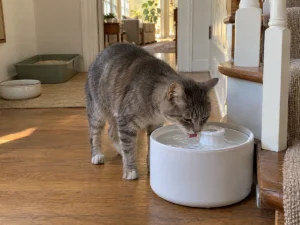
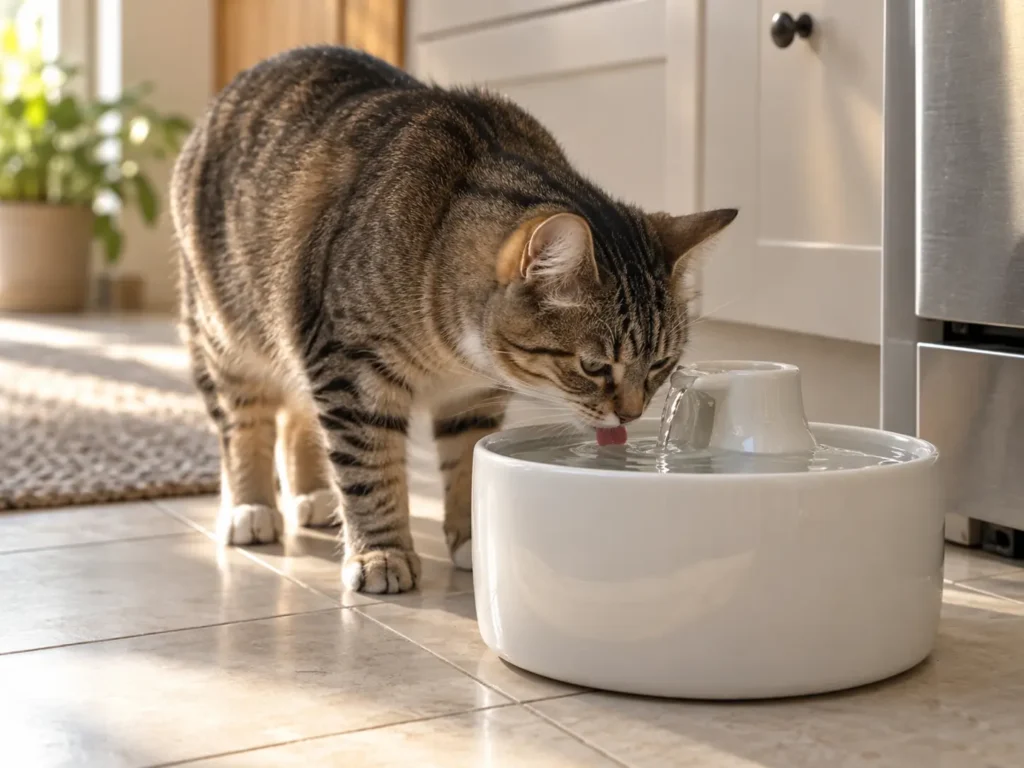
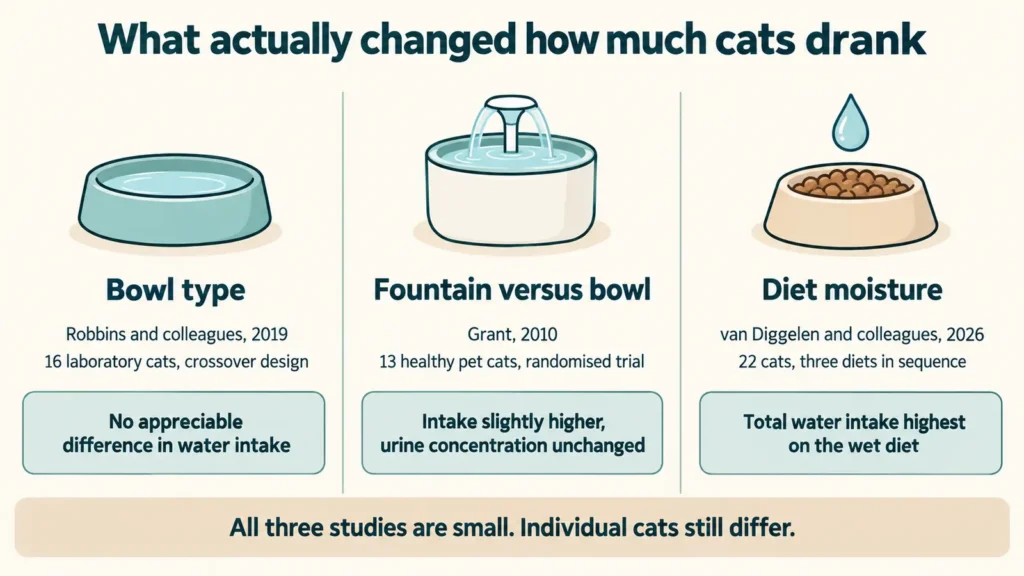
The most directly relevant study is a randomized trial by David Grant, published in the Journal of Feline Medicine and Surgery in June 2010. Thirteen healthy cats living in their owners’ homes had 24-hour water intake, urine osmolality and urine specific gravity measured with water offered from either a bowl or a fountain.
One cat had to be withdrawn after developing excessive barbering, vomiting and refusal to drink the water offered from the fountain. For the remaining twelve, intake was slightly greater from the fountain. Urine osmolality showed no significant difference. The author’s own conclusion was blunt: in that study, a fountain failed to substantially increase water intake and dilute urine in cats.
The withdrawn cat is worth noting on its own. A fountain is a new object that hums and moves, and a minority of cats find that aversive.
The three-bowl crossover study
A larger and more thorough test came from Robbins and colleagues, published in the same journal in August 2019. Sixteen healthy laboratory cats fed a dry diet were housed individually with urine collection systems and cycled through three water presentations in a randomized crossover: a still bowl, a circulating bowl and a free-falling bowl. Each cat spent two weeks on each system with a week of acclimation between them, and fourteen completed the study.
Average daily water intake did not differ significantly between the three systems. Neither did urine volume, urine specific gravity, or relative supersaturation for struvite and calcium oxalate, which are the measures that matter for stone formation. Urine osmolality was the single parameter that reached significance, and it was higher with the circulating bowl, which is the opposite of the intended direction.
Three individual cats did show a statistically significant preference. One preferred circulating water, one preferred free-falling, and one preferred still. The authors concluded that bowl type had no appreciable effect across the group, and that owners needing to raise a cat’s water intake should look beyond novel bowls.
What did move the number
Diet did. A study by van Diggelen and colleagues, published in the Journal of Animal Science on January 8, 2026, followed twelve colony-housed cats and ten privately owned cats through three diets in sequence, two weeks each: fully dry, half dry and half wet, and fully wet.
Free water intake, meaning what the cats drank, was highest on the dry diet. Total water intake, which adds the moisture in the food, was highest on the wet diet in both groups. Both findings reached a significance level below 0.001.
Two further observations from that study are useful in daily life. Cats drank more in the period after a meal than when fasted, again below 0.001. And water intake rose briefly for roughly 24 hours after each diet change, which is a reminder that short observation windows can mislead.
Where this evidence runs out
Honesty about study size matters here. Twelve, fourteen and twenty-two cats are small samples. A real effect that is modest in size could easily hide in numbers that small.
The cats were also healthy. None of these studies tested cats with existing urinary disease. A fountain that does nothing measurable for a healthy cat may still help an individual patient, and the reverse is equally possible.
Finally, the fountains used were the models available to those researchers at the time. Filtration, flow rate, noise and bowl shape all vary, and none of these trials set out to compare designs against each other.
So why buy a fountain at all?
There are sound reasons that have nothing to do with volume.
- Circulation and filtration keep water visibly cleaner between changes, which matters in a household where the bowl otherwise collects hair and dust.
- A larger reservoir means the supply does not run dry during a long day out.
- Some fountains log how often the pump runs or how much the level drops, which gives you a rough behavioral baseline. A cat that suddenly starts drinking much more is worth a veterinary appointment.
- A minority of cats do prefer moving water, and that minority is real even if it cannot be identified in advance.
For more total water, the lever with the strongest evidence behind it is the food bowl. Adding wet food, or adding water to existing food, raises total water intake in a way that changing the drinking vessel did not.
Practical steps that follow from the research
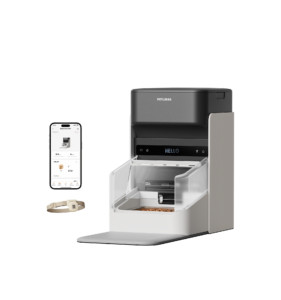
Offer both, at least at first. Run a fountain such as the PETKIT EverSweet Solo 2 alongside the existing bowl for a couple of weeks and watch which one your cat uses. Preference is individual, so let the cat decide.
Watch beyond the first day or two, since intake shifts temporarily after any change. Place water away from the food bowl and the litter tray, and offer more than one location in a multi-cat home. Keep the pump clean, because a fountain that is not maintained becomes the least appealing water in the house.
And if the goal is treating or preventing urinary disease, treat the fountain as a convenience rather than a therapy, and talk to your veterinarian about diet. That is where the measured effect lives.